Store selector: No store selected

Tell us about yourself:“I’ve enjoyed building things pretty much most of my adult life, be it welding or woodworking.”
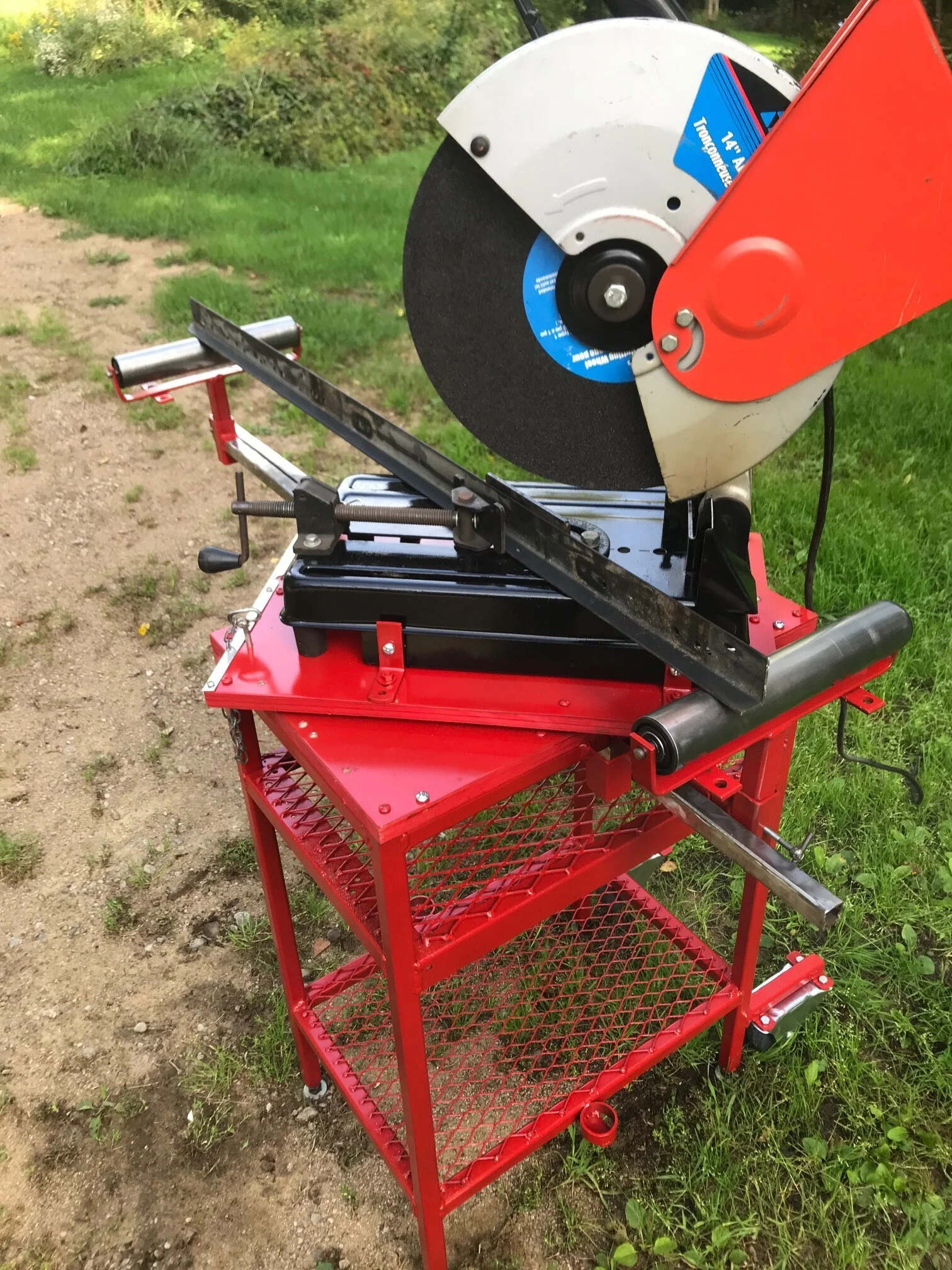
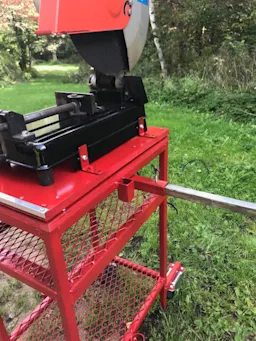
You can’t beat a chop saw when it comes to cutting metal tubes and bars. But when there’s a lot of cutting to do, working at a comfortable height makes all the difference. Peter designed and built this stand with some nice features to make cutting jobs safer and easier, with less back strain!
Great project, Peter! Thanks for sharing it with us!
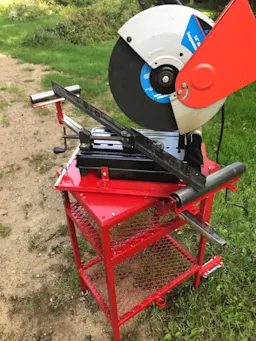
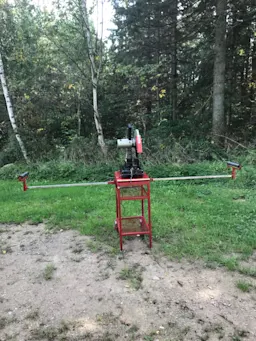
What is it? This is a simple stand for a 14-in. chop saw with extendable support arms and a pivoting table top, so that the supporting arms can still support the material being cut as the chop saw itself does not pivot — only the clamping vise on the saw pivots.
I can easily cut steel and other metal while supporting it at a good working height. After 20 years of either kneeling on the ground to use my chop saw or putting it on a less-than-stable folding table at a height guaranteed to cause back pain, I built a simple stand inspired by similar projects I viewed on the internet. I wish that I had made it last year before I built a cab for my farm tractor – it would have saved me quite a few backaches.
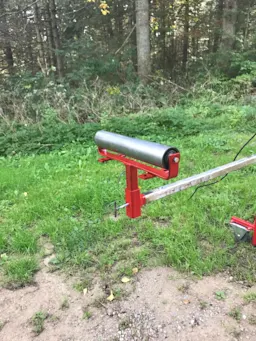
This moveable stand is made from 1 in. square tubing (1/8 in. wall thickness), with the chop saw set at waist height. It’s bolted to a bracket on a pivoting tabletop (using a 12 in. turntable bearing attached to two sheet metal-clad plywood pieces). It has two adjustable extendable support arms (with an adjustable-height roller on each), two shelves, and two 4 in. casters on the back so the stand can be tilted off its adjustable feet to easily move it. I opted for this way of moving the stand around rather than having four casters, because most times I cut steel on a graveled surface just outside my workshop.
The supporting arms are removable and store vertically in brackets on each side of the stand. The adjustable hand screws are 1/4 in. – 20 TPI bolts with a small 1/4 in. diameter rod welded each head; the 1/8 in. thickness of the steel tubing lends itself well for 1/4 in. – 20 TPI tapped holes. While not shown, I also have two separate adjustable supports that I use when cutting longer pieces of steel.
What is the main power source for your project? (e.g. electric motor, gas engine etc.) 110 V electricity for the chop saw.
How do you control your project? (e.g. hydraulic control valve(s), electric switches etc.) Simple manpower to place/adjust the material being cut by the saw.
What components are used to perform the work for your project? (e.g. hydraulic cylinder(s), hydraulic motor(s), sprockets, pulleys etc.) The chop saw itself with the 1,000 lb-capacity 12 in. turntable bearing allows pivoting and the 12 in. rollers on the adjustable support arms facilitate support and movement of the steel material being cut.
What design/build challenges did you overcome? The 1 in. tubing (1/8 in. walls) of the supporting arms slide inside 1-1/4 in. tubing (1/8 in. walls) welded to the underside of the top of the frame. Because of the internal weld (ridge) in the 1-1/4 in. tubing, I had to grind a furrow along the 1 in. tube, plus grind and polish it so it would fit and slide inside the 1-1/4 in. tubing. Because of a slight bend in the tubing I used, I had to straighten it using my shop press.
If you had to build it again, what would you do differently? I would find and use 1-1/4 in. tubing that didn't have a ridge inside the tubing.
Which Princess Auto location do you visit most? Online, unless I happen to be travelling through cities where there is a store.