Store selector: No store selected

Tell us about yourself: “I am a retired heavy equipment and diesel tech in Ontario. After finding a new owner for my company I was at a loose end. Always programmed to be fixing, repairing, redesigning, improving or making stuff. I had to find something to do.
My first project, a long-standing dream, to design and build a fully functional stand-alone machine, worthy of the effort of my own, built with my own hands.
I designed and built the “Komodo”, a 110 HP cross-kart (a kind of compromise between an ATV and a single seater off-road race buggy). It worked out much better than I expected, and gave me a lot of fun building and using it.”
What is it?
After the Komodo project was finished, I was ever restless to make something interesting, I had to find something else…… I bumped into a local guy who introduced me to the idea of CycleKarts.
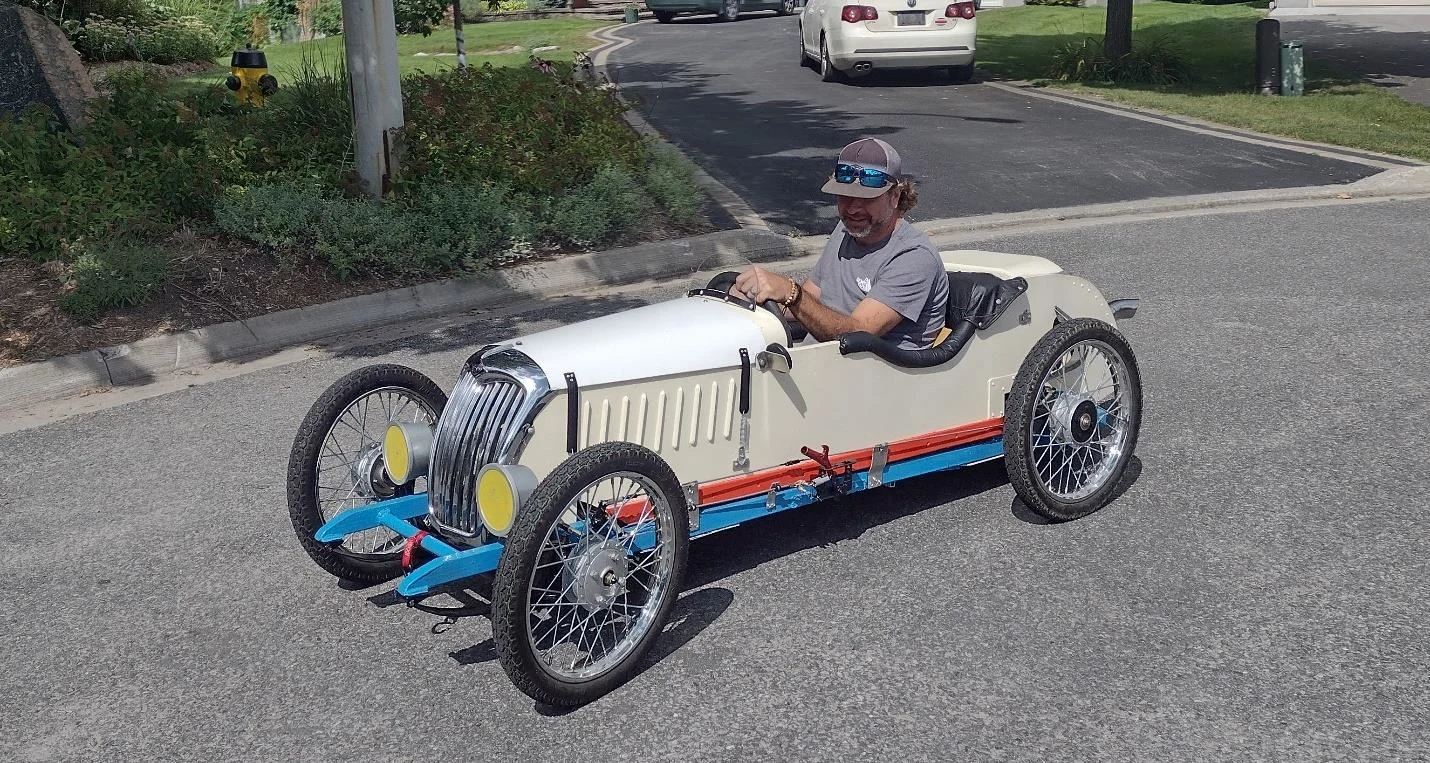
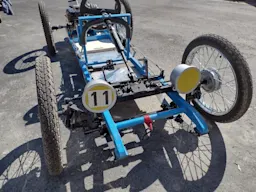
CycleKarts are small, simple open-wheel karts with 17 in. spoked wheels with a a metal, fiberglass or wood chassis and powered by a 200cc 6.5 HP single-cylinder, four-stroke engine. Most people’s first efforts have solid axles, with a single disc brake and some version of Go-Kart steering or rack and pinion for steering using pre-made front hubs.
These karts are something like a sort of scaled-down caricature of the “inspiration car”, which is typically using a 1920-1950 open-wheel spoked wheel race car of that age for “inspiration”. I chose to base mine on a late 1930’s “Riley Brooklands”, which was a very successful race car of its age. The kart cannot be scaled perfectly, or even closely, because the driver will always be full size.
The body is open for the builder’s own interpretation/imagination. Body materials can be fiberglass, aluminum, wood, or whatever works. I used a scrapped, very thin plywood packing case from a log splitter to make the body.
The “footprint” of the little car is something like 66 in. wheelbase and 40 in. track, although the overall length is usually a bit longer because the body may overhang at the front, rear, or both. For practical purposes, it is best to keep the overall length short enough to fit in the bed of a full-size pickup truck or in the back of a van with the rear door open.
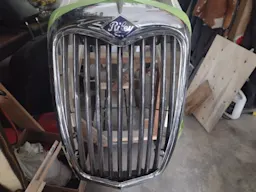
After (rather a disastrous) attempt at making a badly botched Riley radiator grill myself, I enlisted the assistance of my trusty friend, “Mr. eBay” in the UK.
Of course, he had just what I wanted in the form of the distinctively “Riley” rad grill from a 1980’s Riley Mini. When it arrived it was EXACTLY what I had hoped it would be. It was small enough to fit perfectly as a distinctively “Riley” focal point of the kart. I (sort of) scaled the rest of the cart around the size and shape of the radiator grill. Worked out much better than I imagined it would.
There is an unofficial budget of something like $2,500 max. to build a CycleKart so the build effort goes much further and better if you can source used, recycled materials wherever possible.
The whole point of the CycleKart community is to build karts very economically so it does NOT turn into “the most money wins” the races. Spec-karts are built to be close to each other with spec engine, wheels and basic layout. After that the size and design/build depends on the builder’s preference, imagination and skills, but really there is nothing complicated or even technically challenging. All components are readily available new or used, for reasonable money.
What is the main power source for your project? (e.g. electric motor, gas engine etc.)
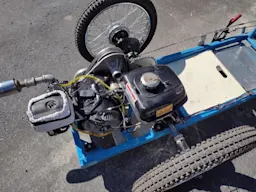
Engine: Honda GX200cc utility engine or clone. I used a Pro.Point 212 CC 6.5 HP engine with integral fuel tank, muffled exhaust and electric start.
Drive system: Comet (or clone) TAC/CVT variable belt-drive torque-converter.
Other materials: Rear axle, bearings sprockets and weld on hubs, throttle cables, brake caliper and pads, #35 chain, choke cable and some other stuff.
What components are used to perform the work for your project? (e.g. hydraulic cylinder(s), hydraulic motor(s), sprockets, pulleys etc.)
Throttle control: Custom-made pedal with sourced cables spliced together.
Drive system: Automatic, variable self-adjusting belt drive torque converter drive according to engine speed. Chain drive between torque converter and the 72 tooth axle drive sprocket.
Brakes: Brake is with a mechanical brake caliper operating on the chain sprocket (to save weight).
Electric start: The kart is fitted with a very small AGM 12VDC motorcycle battery. The engine comes with a short loom which was extended to reach a convenient location in the cockpit at the drivers hand.
Steering system: Rack and pinion system.
Front wheel hubs: Salvaged components from a small, scrapped ATV. These adapted well to the track rods that came with the rack and pinon system.
Axles: Solid rear axle, independent front suspension using old snowmobile springs and beam axle.
What design/build challenges did you overcome?
First off, there is a budget limit for CycleKarts that will be raced together. Finding a formula that uses the basic specs of a CycleKart (from the CycleKart web site), making it strong enough, light enough and maneuverable enough may take a bit of thinking in the planning stages. But all the challenges were worthwhile. It was MUCH simpler than the Komodo, and only took three very leisurely months in the winter to build all of it. If I built another I “could” probably build one from scratch in three weeks or less, if I had all the materials on hand first.….. but I would miss the enjoyment watching it grow at a slow and interesting pace.
If you had to build it again, what would you do differently?
Not much, I have already built a second CycleKart. This one is modeled on a Morgan Three Wheeler (his name is “Crossbow”). It is lighter, faster but not as steady as a four-wheel kart… obviously!
“Crossbow” took a month and a half to build... But he is not built to the CycleKart spec list so he is not a true CycleKart.
Which Princess Auto location do you visit most?
Whitby and Kitchener where the staff are always competent and helpful. Both locations have good stocking levels for the kind of stuff I need. You KNOW you go to a store MUCH too often when they know your name! Always friendly and helpful staff.