Store selector: No store selected

“I am a pharmacist by profession, but my passion lies in troubleshooting problems, and inventing and creating solutions to these issues. I like to think that I inherited these traits from my late father, as there was never a time, even when it appeared that there wasn’t a solution to a problem, that he didn’t have an answer. He always had a way to solve a problem, devise some gizmo to reach a goal—there was always a way—it just took some time and patience to think things through. Now, as a grown man, faced with day-to-day dilemmas and predicaments, I just say to myself, “what would dad have done?” and inevitably, I am able to overcome most obstacles. I truly have my dad to thank for this!”
If your kids are old enough, mowing the lawn is a rite of passage. We parents have to be patient as we pass down the lessons we’ve learned as we went through our own training. Kids do like to cut corners, though, so our wisdom and experience may get ignored (ah, youth). Despite this, Robert’s invention helps the operator avoid damaging shrubs, flowers and gardens with a simple “lift and hold” while the lawnmower passes closely through, at the same time alerting you if there are any hidden obstacles lying in their path.
Clever idea, Robert! Thanks for sharing your project with us!
What is it?
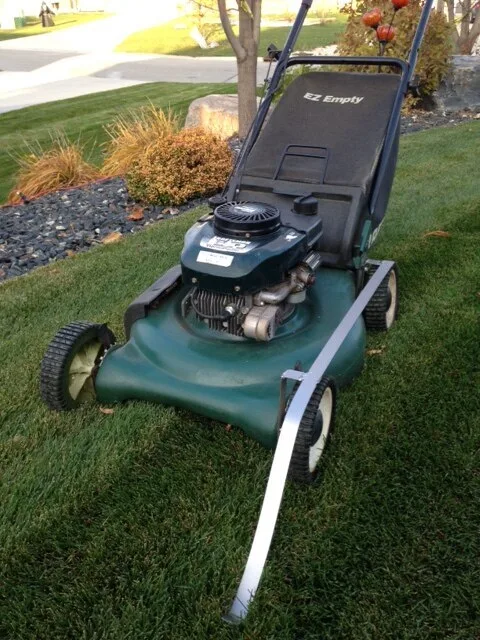
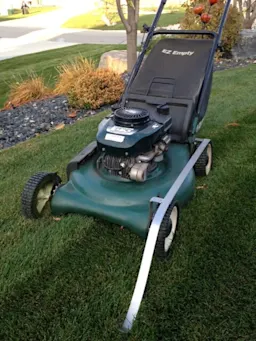
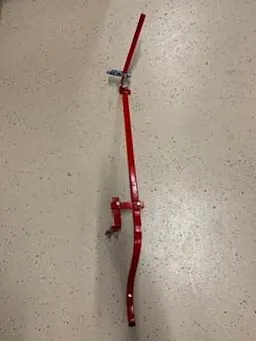
The device I’ve created mounts on a walk-behind lawnmower and will virtually eliminate the need for a weed eater by allowing for an extremely close cut to shrubs, flowers and gardens by lifting up branches and stems, allowing the mower to pass through and cut the grass, then gently lowering and restoring them to their original resting position.
Many years ago, when I was a child, cutting grass was a chore my siblings and I would try to complete as quickly as possible. In our haste, it wasn’t uncommon to take short cuts and we often damaged mom’s pride and joy—her shrubs, flowers and gardens, by cutting super close to them—trying to avoid having to use the weed eater. This infuriated her to no end, so my inventive father fabricated a device to save her plants from the fate of the blade. It worked like a charm, saved her precious botanicals, and it didn’t hamper the speed at which we could finish this weekly chore—in fact it may have been quicker as we all but eliminated the need for the weed eater. Now fast-forward 40 years: I am going through the same things with my kids, so I decided to revisit the attachment, and try to perfect a prototype for my lawnmower, but also be easily adaptable to other walk-behind lawnmowers.
What is it used for? It was designed to essentially lift up and hold up branches, stems, twigs etc. from shrubs, plants and gardens, while allowing the mower to pass by as close as possible, eliminating the need for a stringed trimmer or weed eater. Its unique design will also pick up anything lying in front of the mower such as electrical cords, garden hoses, skipping ropes and so on.
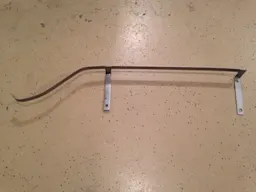
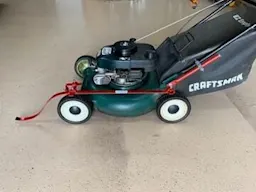
What design/build challenges were overcome? In the original, initial design, the attachment is made of steel: 1 inch in width and 1/8 inch in thickness. It is comprised of a horizontal piece, which has a downward bend at an approximate 45° angle, beginning just ahead of the front wheel, and then bent to a horizontal orientation again, ending with a slight upwards curl. Attached to the horizontal length are two brackets made of the same material. They each extend perpendicular to the horizontal length, and then have a 90° bend and extend downwards where there is a hole at the end to mount to where the wheel is installed. This attachment is mounted opposite the discharge chute of the mower. It does not interfere with the height adjustment mechanisms of the mower, nor does it affect the mower’s performance in any way. It is simply designed to lift things out of the way without having to move things manually. The present design maintains this “spirit” of The Lawnmower Fender, but attaches to any mower in a different manner.
If you had to build it again, what would you do differently? The attachment has gone through a number of iterations as the original was customized to my father’s particular lawnmower. I first made it suitable for my own lawnmower…and it worked (and still works) perfectly.
However, if it were to be used on other lawnmowers out there, it would need to be adjustable. The second prototype had adjustable “legs” along the body of the attachment to accommodate for different wheelbases…again…worked just fine.
Some lawnmowers now have larger wheels on the back and smaller ones on the front, so I needed to make it adjustable height wise as well. This would be the third prototype, which again, worked great.
Some input given to me was that the average homeowner might not want to fiddle around with removing wheels, installing spacers and so on—especially with self-propelled RWD or FWD models. So I was tasked with yet again coming up with a solution. The fourth prototype utilized a clip-type mechanism to attach to the mower body/housing…fully adjustable but perhaps not applicable to every mower, so I went back to the drawing board yet again, to try to come up with another design.
The fifth prototype, which is the current one, can now be installed in minutes on virtually any mower…walk-behind, RWD, FWD, large wheeled, small wheeled, differing wheel bases, etc. No wheels need to be removed, and it only requires a 7/16 inch wrench for installation.
Oh, I guess there is a sixth prototype, as I have created a breaking point in the middle to make it easier for shipping…bringing down the packaging to a box around 20 inches from what was closer to 40 inches. This is where it stands right now, this sixth prototype, which also has a patent pending status.
I don’t believe I would have changed anything in this project. I took the time to think things out well and believe the end product shows that.
Which Princess Auto location do you visit most? Panet Road in Winnipeg, MB.