Store selector: No store selected

Tell us about yourself:“I'm a travelling information security sales engineer and small farmer. We do a lot of work on the farm ourselves from mechanical work on our tractor and saws, welding, plumbing, electrical, and maple syrup. We design all our own machines to solve problems on the farm. Princess Auto is a favorite destination and my 11 year old son has the bug.”
Anybody who has ever plucked a chicken manually knows just how much time it takes. According to the Guinness Book of World Records, the fastest time for hand-plucking one chicken was 4.4 seconds. Three chickens in a row totaled 32.9 seconds. Feathers were flying, no doubt about it.
Inspired by the industrial-sized machines and smaller units he’s seen around, Hank decided to make a similar machine for his own use. Simple in design yet efficient in its purpose, this poultry plucker has definitely been a time saver!
Great project, Hank! Thanks for sharing it with us!
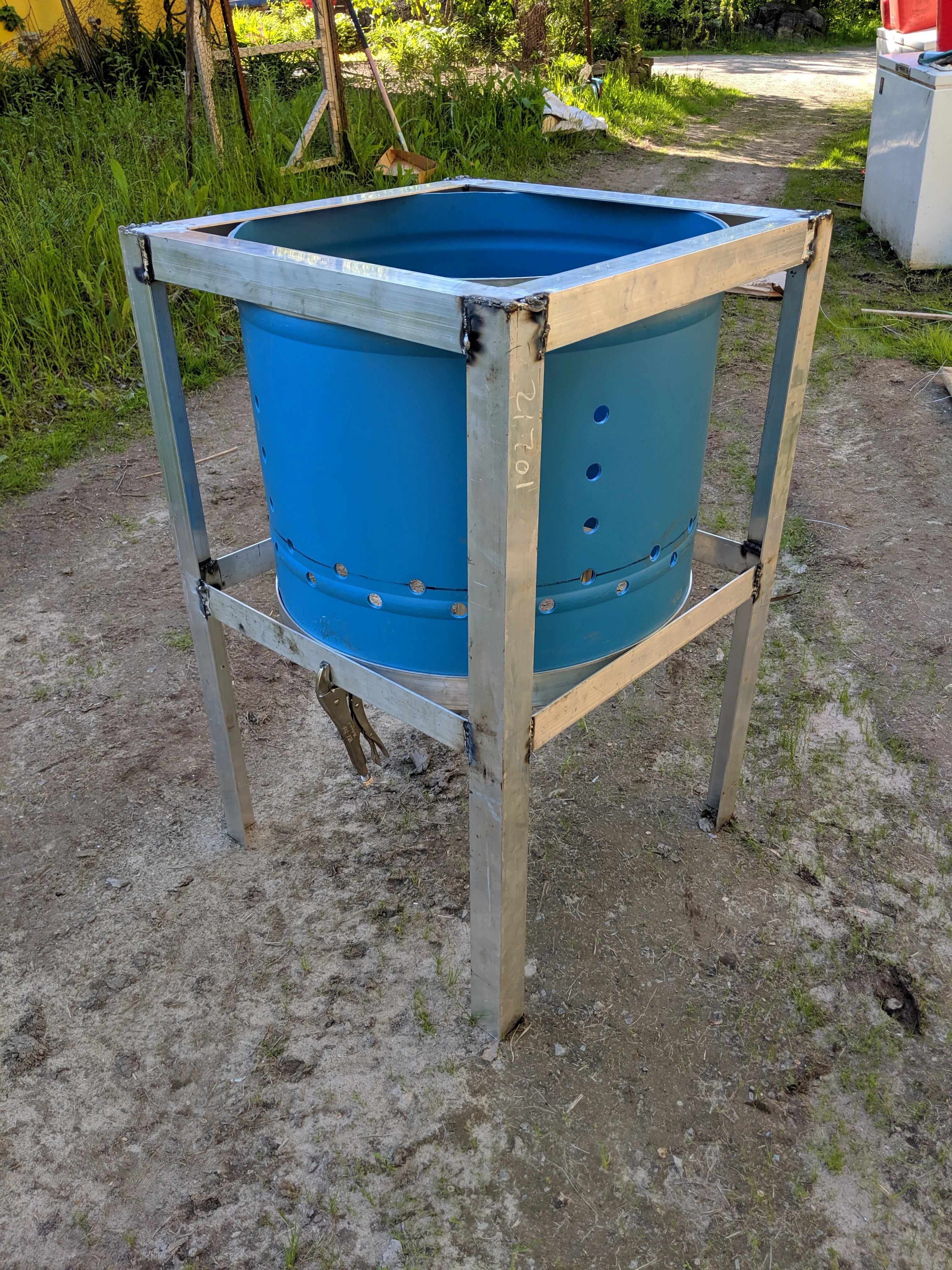
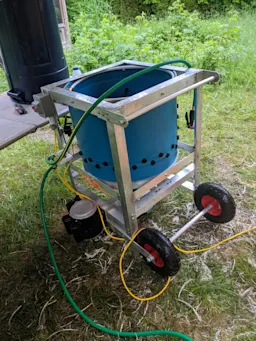
What is it? It's a chicken plucker. You place a dead, scalded chicken in the plucker and it removes all of the feathers rendering the chicken ready to dress. It's MUCH faster than hand plucking. It uses a spinning aluminum disk populated with rubber plucker fingers and a fixed drum also populated with rubber plucker fingers. It's a small unit suitable for a small operation like family farm, but it works great and has actually been borrowed a couple of times by other farms.
We had been using a small, local, family owned abattoir to process our chickens. They use a large, industrial scale chicken plucker. We looked around to see if there were smaller ones available and saw that a number of people build what are called Whiz Bang chicken pluckers. They use a section of blue barrel and commercial chicken plucker fingers and are generally built with a wood frame. I am an amateur welder and wanted something lighter that would stand up better, so I decided to go with aluminum.
When we processed chickens ourselves, we ended up plucking them by hand. That's a long and annoying process as it's hard to get all of the feathers and the oils on the chickens' skins and the water from the scalding make the feathers stick to your hands. It's ok if you're only doing two or three or if you're just getting one for supper but if you're doing 15 or 20 or 100 it's a real pain in the tookus.
It is utterly amazing. It reduces the time that it takes to pluck a chicken well from 10 minutes to 15 seconds. We were able to process 50 chickens in a single day down to fully ready to freeze. Harvest day is never pleasant but the plucker has made it quicker and easier.
What is the main power source for your project? (e.g. electric motor, gas engine etc.) The main power source is a 1HP electric motor I bought from Princess Auto.
How do you control your project? (e.g. hydraulic control valve(s), electric switches etc.) The electric motor is turned on by a switch, which also opens a solenoid valve to spray the walls of the drum with water to wash away the plucked feathers.
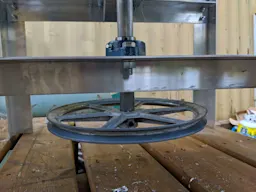
The speed of the disk is set by the combination of the pulleys from the motor to the shaft. The tub is fixed to the frame. The bottom disk spins, which tosses the chicken against the walls. The fingers on the disk and on the walls rub the feathers off the bird. The bird has to be scalded first to loosen the feathers. They are dunked in a hot water bath until the large wing feathers loosen. Then you just toss them in and the go for a spin for a few seconds and they are naked.
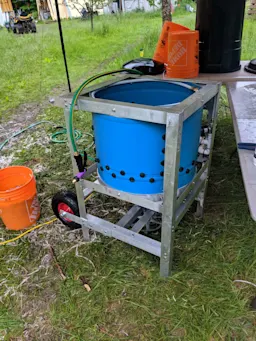
When I turn on the motor the water turns on as well. I have a 110V solenoid connected to the switch, so that when the motor is turned on the solenoid opens allowing water to spray through holes in the 1/2 inch PEX tubing around the top of the tub.
The green hose you see in the pictures is connected before the solenoid so it can be used to wash down tables and the machine as the day or harvest goes on. I use that hose to spray off the birds, to rinse out the cavities, to spray down the tables to keep the work area clean, and to clean up the plucker once we're done.
I have also moved the motor from the side to above the wheels. That makes the machine narrower and easier to get in and out of places and moves the center of gravity over the wheels, which makes it easier to drag around by the handle. It sits on its feet when it's standing up and rolls on the wheels when you tilt it back toward the handle.
What components are used to perform the work for your project? (e.g. hydraulic cylinder(s), hydraulic motor(s), sprockets, pulleys etc.) Motor, pulleys, bearings, keyed shafts, belts, conduit, electrical, tires, hose.
The frame is welded and bolted. Some of the joints are welded, some are bolted, and some are welded and bolted. I welded the corners of the top which are likely to get the most abuse. Some of the frame elements are welded. Most are bolted. I chose to bolt the lower parts of the frame so that I could get it apart again to make adjustments or changes to the design after we had used it for a while. The tub is a slice of a straight sided blue plastic barrel. It was marked, drilled, and chamfered to take the plucker fingers.
What design/build challenges were overcome? Maintaining tension on the belt was a challenge. It gets wet and covered in chicken grease and feathers. I had to build an idler arm to tension to the belt to keep the machine running well.
Choosing the correct belt was a bit of trial and error. We started with a belt that was too short and with pulleys that weren't quite aligned which resulted in early failure. With the pulleys aligned and a longer belt we found that it slipped a lot when it got wet and/or greasy from the chickens. I ended up adding an idler and a strong spring to keep the belt tight. The chickens were slipping down between the edge of the tub and the disk but raising the disk so that the fingers of the disk and the fingers of the tub were closer together mostly solved that problem.
If you had to build it again, what would you do differently? I would probably set the wheels a little lower to improve balance but I think we got it just about right this time. I'll probably upgrade to a bigger motor at some point.
Which Princess Auto location do you visit most? Kanata, ON