Store selector: No store selected

“I'm a 52 year old mill worker with an interest in designing and fabrication of some the crazy ideas going through my head. Years ago, I designed and fabricated a hidden trailer hitch for my motorcycle. It had a removable receiver. I sold quite a few of them.”
The term “ATV” first came out in the 1960s to describe amphibious 6-wheelers such as the Versatrek Jiger, the Amphicat and the Terra-Tiger. The first “straddle style” ATV was the 3-wheeled Sperry-Rand Tricart in 1968, but it was Honda’s ATC90 introduced in 1970 that popularized the newest recreational machine. Farmers, ranchers, park rangers and anybody working outside saw the usefulness of the 3-wheeler, and suddenly manufacturers had a new demographic to focus on.
As fun as it was to ride, the balloon-tired trike was also making headlines as a dangerous vehicle. When Honda began phasing out their ATC line by the late 80’s, they produced the Fat Cat, a 2-wheeled version to compete against Yamaha’s Big Wheel motorcycle/ATV hybrid. Today, ATVs are generally associated with four wheels, which continues to dominate the market.
Ken found an old ATV frame and decided to turn it into a fun little machine, which goes to show that if you can dream it, you can build it.
Great job, Ken! Thanks for sharing your project with us!
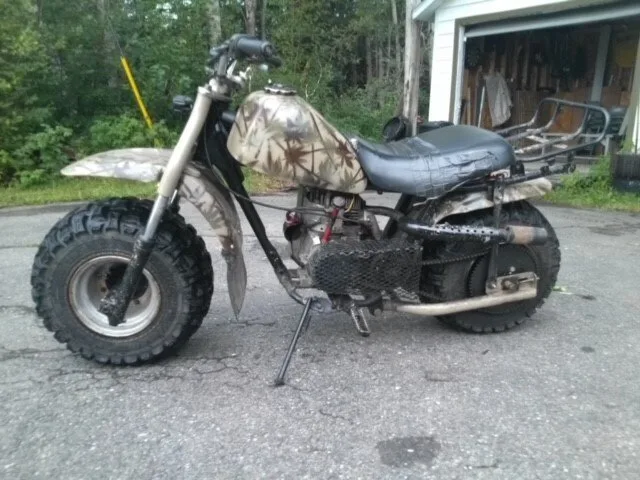
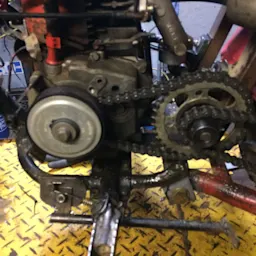
What is it? This is a modified Honda ATC converted to a big mini-bike with an 8 HP snowblower motor. As a child, I always wanted a mini bike. I was looking for a winter project and I noticed a similar bike on Pinterest. I was going to build one just like it (with the ATV engine), but I used an 8 HP snowblower engine. All the drive chain, sprockets, jackshaft and clutch were purchased from Princess Auto either in-store or online. This is a fun recreational bike for cruising the backwoods trails.
What is the main power source for your project? (e.g. electric motor, gas engine etc.) An 8 HP Tecumseh gas engine.
What components are used to perform the work for your project? (e.g. hydraulic cylinder(s), hydraulic motor(s), sprockets, pulleys etc.) 8 HP motor with a centrifugal clutch sporting a #40 chain, a triple pillow block, jackshaft for a gear reduction, and offset for the rear wheel.
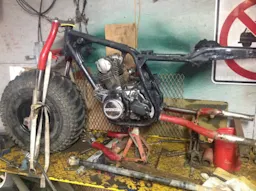
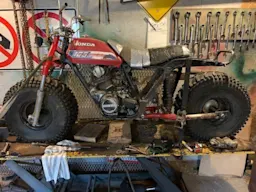
What design/build challenges were overcome? I acquired an ATV frame that had rusted through, and I had to make the engine fit in the frame. I also cut away the rear frame to make room for a swing arm for the rear wheel, while trying to keep it all straight and true with the front. There were no blueprints or pre-designing: it was all done on the fly. Research and development can get expensive!
The first and biggest challenge was the design and placement of the jackshaft in relation to the rear wheel and alignment of the two chains. Sounds easy if you just throw metal at it, but I wanted to keep the weight down. After the first test ride, I needed to learn about gear ratios. I’m pushing over 270 lbs, so this thing needed lots of low end power but had to be able to go fast enough to maintain balance.
It took me the winter of tinkering in the garage to get it assembled and tuned in enough that I could ride it. If it hadn’t been for Princess Auto, I likely wouldn’t have been able to get the project completed successfully. Parts weren’t available locally. I’ve since sold that bike to a young fella who was the right fit for it, re-geared it for him and off to trails he went! Smiles all around.
If you had to build it again, what would you do differently? I have since started another. This one will have the original ATC motor and gearing for power and speed (as the ATC had from the factory). This bike will be sporting rear suspension just to complicate the designing of the swing arm. I’d also like to incorporate disc brakes on this one. Rest assured, I’ll be shopping Princess Auto for parts and inspiration.
It will still require a jackshaft, but the Hi/Low range manual transmission of the ATC and its motor solves any gear ratio issues. Why re-invent the wheel...
Which Princess Auto location do you visit most? Moncton, NB