Store selector: No store selected

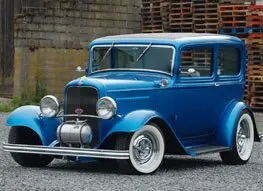
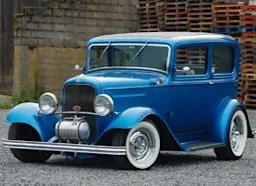
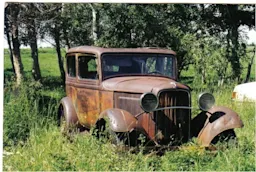
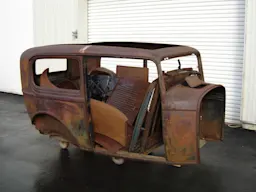
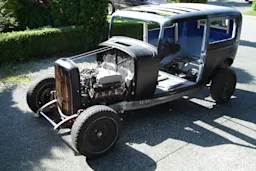
“I got my first car, a 1947 ford for $100 paper route money. The car I was driving at 16 was a 1949 Plymouth, which a gentleman in my old neighbourhood of Point Grey Vancouver gave me for cutting his lawns all summer. I have been deep in the hot rod hobby for most of my life. I put a 350 Chev with turbo 350 in my 47 Ford in the back lane of my parents’ house with parts I bought at swap meets and local car builders. I traded my 47 Ford, as a driving car, for the barn find 32 Ford you see in the original pictures. It was a long 20-year journey building this car.
I have been the chairman of a local hot rod club called the Pacific International Street Rod Association for over 22 years now. I have been an active member of the Coastal Swap Meet committee since the 80's. Old cars are such a great social hobby....you find friends all over the place.”
The definition of “barn find” is basically when you come across a classic vehicle of some sort (car, motorcycle or airplane, for example) that’s either been left outside to gradually deteriorate, or was tucked out of sight in barns or sheds (and exposed to bird droppings, insects, mice and other vermin to deal with). Despite decades of neglect, these discoveries remain of great interest to those who enjoy collecting or restoring a piece of motorized history. Rob’s car project transforms a discarded classic car into an eye-catching hot rod. We can’t get enough of that gorgeous blue paint and Tiki stick shift knob!
Fantastic restoration, Rob! Thanks for sharing it with us!
Q: What is it?
A: It is a 1932 Ford Tudor Sedan that was found in a barn in Airdrie, AB where it had been sitting for almost 40 years (it had 1953 plates on it and we found it in 1994). A friend in Alberta was called to get the car out of the barn and I quickly made a deal trading my 1947 Ford Coupe for it.
A: I built this Hot Rod in a 60’s theme. All famous show cars in the old days had names, and so while planning to enter my first car show, I needed a name. The dream of Hawaii and a love for Tikis helped. The car became the Tiki Dream. The car was displayed “floating” on a huge cloud of cotton batten (they used fibreglass angel hair in the 60’s but it was found to cause cancer) with giant Tikis on each corner.
A: It’s used for car shows, driving events and cruising the countryside. The car has been in lots of shows and even a few magazines. It got featured in the ICBC calendar in 2015. But now, I mainly drive the car. I was never really a car show guy, and enjoyed the swap meets and hunting for parts more. Rain or shine, we drive the car to events from Osoyoos to Portland. I spent so long building the car, I now want to drive the wheels off it.
Q: What is the main power source for your project? (e.g. electric motor, gas engine etc.)
A: The engine is a 1994 302 cu inch Ford V8 racing motor meant for the can-am propane circuit in the USA, but never raced. It was given to me as a gift. I matched up a 1990 five-speed transmission and we were set. Every system has been upgraded to modern equipment.
Q: What design/build challenges were overcome?
A: The first 8 years were collecting parts as I started wheeling and dealing 32 Ford parts online and at swap meets. I had kids and a new house so money was tight. Fast forward to 2000 and the car really made progress. It was painted in 2011, and driven by spring 2012.
A: The body was pretty solid when I got it, but the west coast moisture really did a number on it in my garage. We had to replace quite a few spots along the lower belt line and replaced the wooden floor with metal.
A: The frame received an extra member and box rails for strength. A 1974 Maverick rear end with parallel leaf springs complete the rear. The four inch dropped axle with a 1930 Model A cross member help get the car in the weeds up front.
A: Mechanical upgrades besides newer drive train: front disc brakes, Posi rear end pumpkin, turn signals, seat belts.
A: The engine had the FI (fuel injection) removed and a carb added to stick with the period build. 15-inch tires up front with 17-inch in the rear add to the look and style.
A: Problems, so many we originally named the car Tu-back. Every step forward on this car made me take two back as I learned the hobby of building a hot rod. Every time I made progress, something else wouldn’t fit and we had to back a step or two to change things and put our puzzle together.
A: Most problems were solved by reaching out to people in my car club or in the business. One example was buying parts years before you needed them, as they were a good deal. My SVO headers from Ford leaked in the center of the tube collector, should have taken them back but it bought was five years earlier. I bought a wood kit for the car, but turned out to be for a Victoria sedan and not mine, so the major wood pieces were 11 inches short.
A: Steering column and the engine were fine in the mock up but when it was put together for the final fit, the column hit the motor on every turn. This required a custom notch in my valve cover.
A: Many specialty tools that were bought at Princess Auto: the straps for towing the project around on my trailer, rags, electrical components like an extra power outlet for phone charging, etc. I bought my cable puller (or come-along as it was called where I grew up), step drill bits, tools and so many nuts and bolts.
Q: If you had to build it again, what would you do differently?
A: I would chop the roof 2-1/2 to 3 inches. I would make changes to the wheel wells to allow larger tires.
Q: Which Princess Auto location do you visit most?
A: Langley, BC