Store selector: No store selected

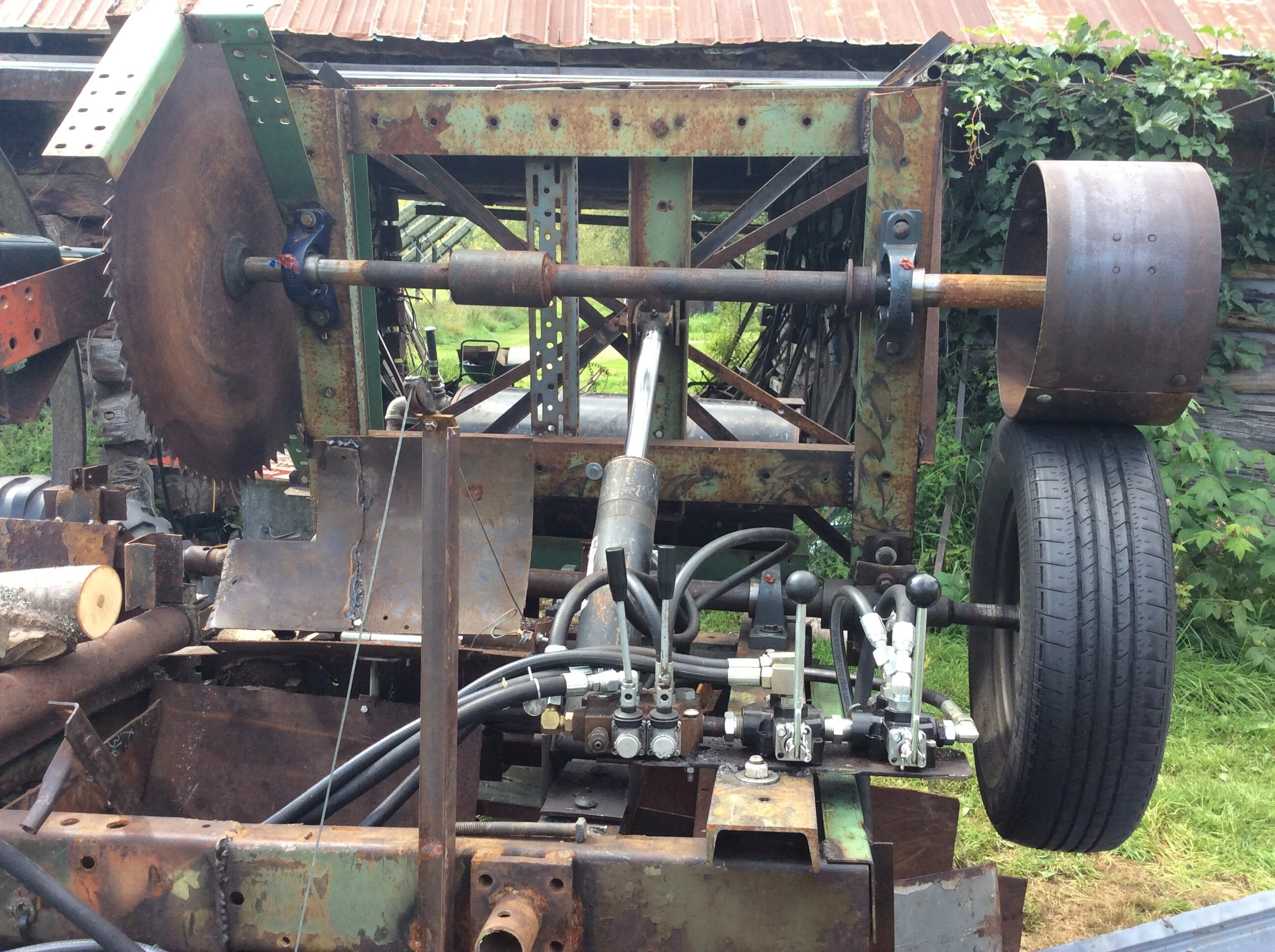
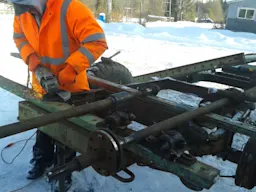
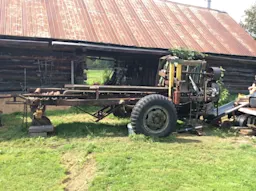
"I am a retired Electrician that likes a challenge and enjoys mechanical projects. A close friend of mine - a trapper, farmer, logger and basically a "jack-of all trades" - wanted a processor for his firewood. With him supplying the material, along with the combining of our ideas, we came up with this unit that we and my son put together. I did all of the welding on the unit and performed the calculations to get the proper speeds required for the saw blade and the hydraulic pump, as well as finding the proper parts that we had to purchase."
If you can dream it, you can build it. Especially when you have a buddy to brainstorm with, and a third pair of hands to assist with the building process. This firewood processing machine took a little bit of "trial-and-error", but in the end, seeing all the components working together as they should turned out to be worth it.
Nice project, guys! Thanks for sharing it with us!
See it in actionhere and here
Q: What is it?
A: This is used to cut and split up to fourteen inch logs into firewood, before being sent to the conveyor that loads the finished wood onto a trailer. My son, my best friend and I built this for the winter burning season.
Q: What is the main power source for your project? (e.g. electric motor, gas engine etc.)
A: The entire machine has its power supplied from the power take-off of a tractor. The power take-off operates the log conveyor system, the circular saw blade, the hydraulic pump to feed the 3 pistons and the hydraulic motor. There is a separate lawn tractor that operates a converted hay elevator into a firewood elevator.
Q: How do you control your project? (e.g. hydraulic control valve(s), electric switches etc.)
A: The machine is controlled by four hydraulic control valves mounted in a safe location for the operator to work with. The valves control the log mover, the saw action, the splitter and the arm to lock the log in position while being cut.
Q: What components are used to perform the work for your project? (e.g. hydraulic cylinder(s), hydraulic motor(s), sprockets, pulleys etc.)
A: We have three hydraulic cylinders on this machine, one is used to lower the circular saw blade, a second is used to lock the log in position for cutting and a third one splits the stove length log. We also use a hydraulic motor to operate a twelve inch conveyer belt that moves the log forward to be cut. We have used a combination of sprockets with chains combined with belts and pulleys that provide the proper speed to operate the hydraulic pump. The barrel is the oil reservoir and we added one of your filters on it for the hydraulic oil feeding the pump. The circular saw is powered with the use of an auto rim and tire that turns a smaller steel pulley to get the proper speed required for the saw.
Q: What design/build challenges were overcome?
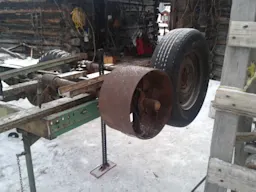
A: The two main issues to overcome were the moving of the log, and then to get the split wood out of the machine without jamming up behind the splitter. We had to bring the saw up to a proper cutting speed to operate properly, and the pump speed had to be increased as well for maximum efficiency. The saw speed was brought up by the use of a sixteen inch tire mounted on a vehicle rim, powered from the tractor power take-off. The tire turns against a sixteen inch cast pulley which approximately doubles the speed to give the saw the proper operating RPM. By using the tire we have incorporated a safety feature: if something was to jam or break, the tire would slip on the pulley. The amount of slippage is determined by the amount of air pressure in the tire. The pump uses a combination of roller chain, and then a set of belts run off a jack shaft to give us the proper operating speed. We had to go to belts for the second step as it was too fast to use chain. We also had to provide a means of adjusting the belt tension to compensate for wear; the jack shaft is mounted on two hinges to allow proper belt tensioning. The last shaft is connected to the hydraulic pump by the use of a rubber spider coupling. Another challenge was to provide a solid way to lock the log in place while the saw was cutting stove length pieces off. The first attempt at a log securing arm was with a manually operated one, but it did not provide enough pressure. Another hydraulic cylinder was incorporated to operate a locking arm assembly. We also had to build crossers into the wood elevator to allow the blocked wood to be picked up and moved to the top of the elevator. Finally, we had to keep everything balanced and in line. Any time we came to an obstacle we would talk it over and put our ideas together to overcome any of the problems. This was an amazing challenge, but we would do it again in a heartbeat due to the satisfaction of building something of this magnitude by ourselves.
Q: If you had to build it again, what would you do differently?
A: We already made the mods to the original unit after the first operation try-out, and once these were done we actually used the unit to cut our firewood. Originally we had two geared rollers to move the log ahead, but they sometimes had difficulty moving the log so we changed them to rollers and installed a twelve inch wide belt instead. Once the wood was split it was forced onto the elevator by the next log being split but sometimes they were getting piled up before tumbling onto the elevator. We improved this by installing a set of four wings that put tension on the wood and placed it in the proper location to fall onto the elevator. The tension on these arms is created with the use of rubber bicycle tubes and works very well. We wanted to be sure that we had worked the kinks out of it before painting. I think the only changes would be to use a larger circular saw blade that would allow us to cut larger than a fourteen inch log if needed. If we used a larger blade then we would make the splitter a bit different to handle the larger logs.
Q: Which Princess Auto location do you visit most?
A: Ottawa, ON