Store selector: No store selected

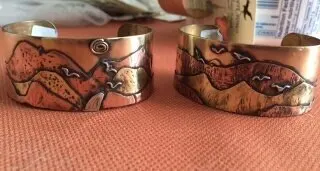
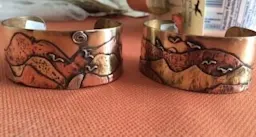
“I live on the east coast of New Brunswick, in a city called Saint John. I have been creating for the last 25 years. I have a degree in cultural anthropology, and whenever I would see the amazing metal work done by the ancient societies, I would think to myself: if they could do this with the resources they had at the time, then I could do it with the resources at my disposal... and the rest is history.”
You’ve got to hand it to all those ancient civilizations for mastering various smithing skills with basic equipment. To be able to craft a variety of useful or decorative items through the heating and shaping of metal requires a certain amount of trial and error. Cheryl researched several techniques to resolve an issue and create unique pieces of jewelry. Judging by the results you see here, that research paid off rather nicely!
Nice work, Cheryl! Thanks for sharing your project with us!
Q: What is it?
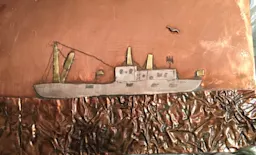
A: I make jewelry and pictures using recycled metals - copper, brass, silver and gold. Some of my pieces are made using copper from the roof of our local cathedral. The vast majority of my tools and supplies come from Princess Auto. Some of the ancient societies that spoke to my creativity were Egyptian, Sumerian, Roman and Greek. It is incredibly mesmerizing to see these influences in my work. It took me a long time to learn how to make them. In reality, they were simple to make
Q: What are some of the tools you used on your project?
A: I have used a few tools: torches, solder, flux, soldering irons, various snips and shears, files, dust masks, needle files, pliers, safety glasses, brass mallets, ball peen hammers, 6mm letter punches, and likely more if I think hard about it. As for polishing, I have a collection of Dremel tools... they are sometimes used to finish a piece. Some come out with incredible results... others are put into the “try again later” category. The best way to finish is by hand, using the Dremel sized drill press. Most of my work is all hand done, from start to finish.
Q: Where have you sourced your supplies?
A: Some of the pieces are made using copper from the roof of our local cathedral. I have been on a project to make pieces of jewelry - I donate more than half of the sales back to the church. I also use metals that are more “down to earth” the rest of the time. I buy old Victorian hand mirrors for the silver, gold and silver rings, and brass planks to work with.
Q: How long have you been making these cuff bracelets?
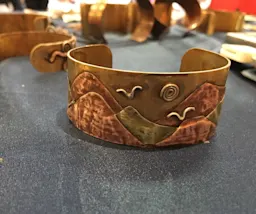
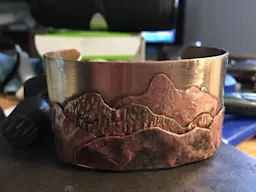
A: The scenery pieces are relatively new (somewhere between 4 and 6 years ago). The layered pieces all tend to be labour intensive. Each cuff bracelet takes about 3-1/2 to 4 hours each. There are many variations to this kind of scenery: there can be winter scenes, summer, fall or spring.
Q: What design/build challenges were overcome?
A: Once I figured out how to make the metals stick together, I was off and running. It's a real pain to control the heat - each metal conducts heat differently. If you make the flame heat too much, you have a piece that is desperate to be cleaned, if it will solder at all. It is always difficult to work on a piece that has contours, but it can be done. At first, I had difficulty with the edges. I solder down the biggest mountain in the background. This is the least difficult to have to solder. The subsequent layers are increasingly difficult. As I apply the heat to the centre part, the edges tend to lift like wings. After brainstorming, I came up with the idea to use alligator clips, but they only are a temporary solution. Vice grips also work to a point, and often scar the metal. Recently I found a solution - iron binding wire... a much better solution than I had realized. It holds everything and does not get stuck on the work.
Q: If you had to build it again, what would you do differently?
A: If I had to do it all over again, I would not change a thing. Trial and error is better because there is more exploring of the properties of the materials.
Q: Which Princess Auto location do you visit most?
A: Saint John, NB