Store selector: No store selected

"I work at a hunting store for a living, but outside of work I enjoy inventing and building things that interest me."
Propeller-driven snowmobiles are nothing new; the first ones appeared in Russia as far back as 1910 (even aviation pioneer Igor Sikorsky toyed with them). They were basically a wood platform on skis, powered by an old aircraft engine. Armour-plated Aerosani ('Aerosled' in Russian) were developed for reconnaissance, patrolling and light raiding operations in northern Russia during WWI, the 1939 Winter War (a conflict between the Soviet Union and Finland), and WWII. These early snowmobiles could easily travel through open areas at a top speed of 35 km/h, but lacked the power to climb hills. Winding forest roads also proved to be problematic.
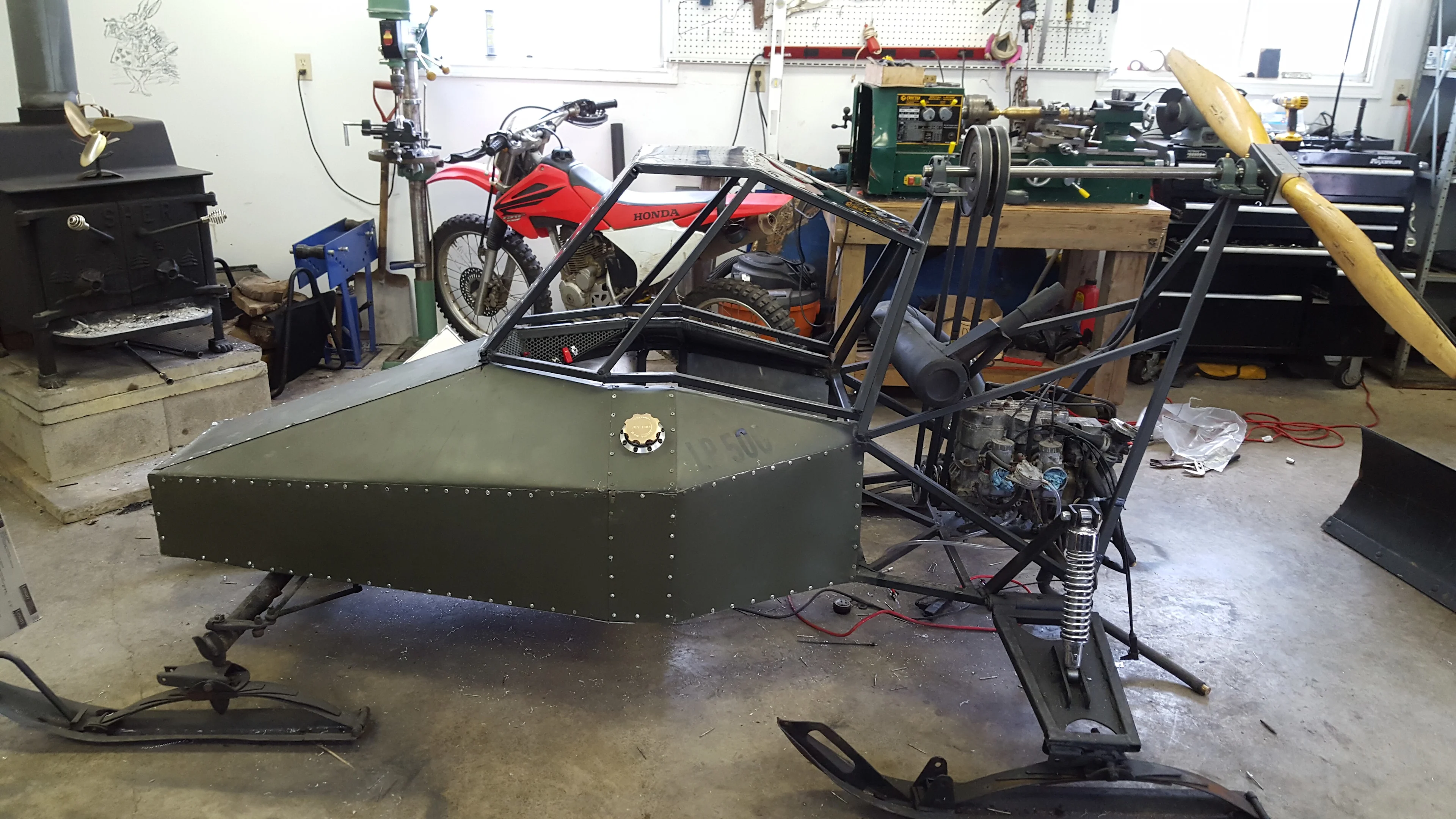
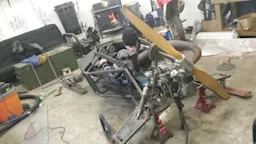
Dave's 'Land Plane' modernizes the classic Aerosani, and sure looks like a fun way to beat those winter blues.
Great project, Dave! Thanks for sharing it with us!
Q: What is it?
A: A propeller powered snowmobile. A friend and I were just looking for something to do over the winter; the idea to build this kind of craft popped into my head, and we just ran with it!
Q: What is it used for?
A: FUN! This thing is designed for enjoyment over big open spaces. One time we ran it, our speed was just shy of 100 km/h; it'll probably go as fast as your nerves can take it!
Q: What is the main power source for your project? (e.g. electric motor, gas engine etc.)
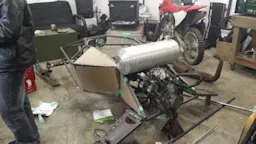
A: A Polaris Indy 500 2 stroke 72 HP engine from an older snowmobile.
Q: How do you control your project? (e.g. hydraulic control valve(s), electric switches etc.)
A: The front skis are controlled by a basic steering assembly, so it handles like a car. There's a gas pedal for speed. We're working on installing an emergency brake, probably a friction brake with a lever that digs into the snow.
Q: What components are used to perform the work for your project? (e.g. hydraulic cylinder(s), hydraulic motor(s), sprockets, pulleys etc.)
A: Lots. The jackshaft attached to the propeller was made from 1-1/4 in. cold finished (rolled) round steel. Bearings, pulleys, V-belts, nuts, and bolts were all purchased from Princess Auto. The windshield frame is hinged at the front and tips forward so you can get in or out. We use a gas shock like you'd have on a hatchback to keep the cage closed. There's 5/8 in. thick Lexan polycarbonate sheets all around the cage for "bullet proof" protection against the wind and flying debris.
Q: What design/build challenges were overcome?
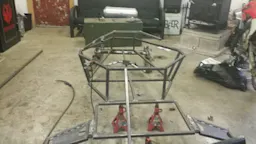
A: We originally designed it chain-driven, but switched to V-belt so it could handle the centrifugal forces. Motor mounts were a huge issue: they always broke due to the high vibration produced by the engine. We machined pockets into the motor base and used Grade 8 bolts to secure it to the frame. The rear suspension was another challenge to set up. We tried a couple of ideas but ended up using the springs from an old VW bus. We've ran it a few times and noticed the nose tended to lift at higher speeds. We tilted the jackshaft and motor to angle the propeller, and that helped to keep the nose down.
Q: If you had to build it again, what would you do differently?
A: More cockpit space would be on the list. I'd like to add some leaf spring suspension on the front, or change the front axle to an A-arm style for independent suspension, just like in the rear. We're saving for a pipe bender in order to build a frame around the propeller.
Q: Which Princess Auto location do you visit most?
A: Used to be the Ottawa store, but we're closer to the new one in Kanata, ON.