Store selector: No store selected

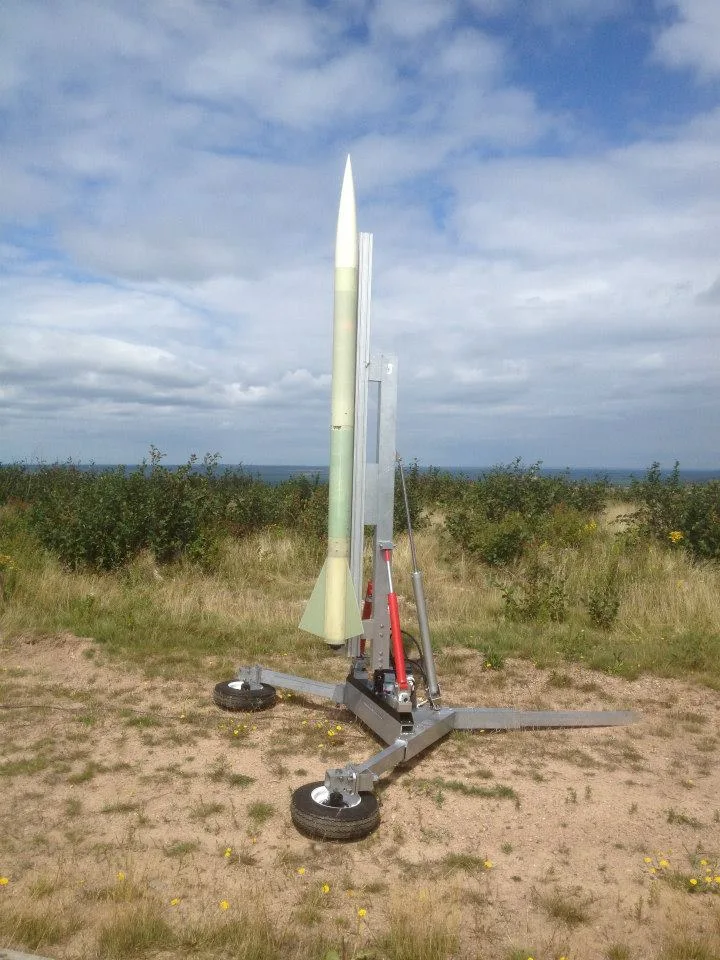
"I'm an electrical engineer with background in renewable energy and power conversion applications. I basically take new ideas and develop them into something practical and useful. I also design, build and fly drones, and hold an amateur radio license. I've been launching rockets for over 10 years. Of course, the size of the rocket has a big impact on the size of the launch pad. But, with large rockets, and with what you see on TV... it's always much more 'COOL' to see a hydraulic rocket launcher. I've built a few rocket launching pads, but this one is definitely the best and coolest!"
Tobie's rocket launch trailer looks like something pulled out of a James Bond movie, which is fine considering the type of rockets he sends into the wild blue yonder. The high-powered rocket shown here (one of 10 that he built) is about 6 feet in length, can have a full load weight around 20 lbs, and can reach altitudes up to 5,000 feet.
Powering this rocket is a single M-Size solid-fuel engine, containing ammonia perchlorate as a propellant (similar to what's used in the Space Shuttle boosters). This type of engine produces about 300 lb of thrust for a duration of 4.5 seconds - enough to bend a steel guiding rod on takeoff and send the rocket anywhere but up (rockets of this type require a guiding rail instead of a steel rod for safer liftoffs). The engine comes with an igniter that Tobie activates remotely from a safe distance. Rocket recovery is done by parachute, but on occasion you'll need a good shovel to dig out your rocket if it fails to open!
Great launch trailer, Tobie! Thanks for sharing it with us!
See it in actionhere and here
Q: What is it?
A: This is a ramp used to launch high-powered rockets. Hydraulics are used to lift the rocket on the ramp and set the angle of launch. I don't tow it on the road, instead, it is loaded in an enclosed trailer. With the few high power launches we do, it's too much trouble to have it road certified. But, at the launch site, it is towed behind a truck to its final position. Low-powered rockets are launched from a base plate with a guiding rod. High power rockets require a rail; the reason is that a 1/2 inch rod could be bent easily during a high power rocket launch.
Q: What is the main power source for your project? (e.g. electric motor, gas engine etc.)
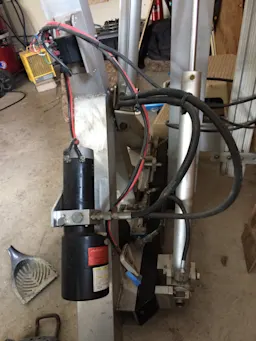
A: The hydraulic is powered by a 12V battery. The pump and most fittings are from Princess Auto.
Q: How do you control your project? (e.g. hydraulic control valve(s), electric switches etc.)
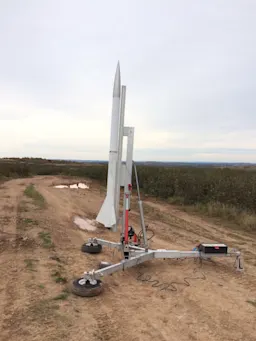
A: This was a pump package - simply up/down for lifting the ramp. The other movements are passive and simply controlled by manual valves. The black box is the launch controller, and controlled from a distance, depending on the size of the rocket/motor.
Q: What components are used to perform the work for your project? (e.g. hydraulic cylinder(s), hydraulic motor(s), sprockets, pulleys etc.)
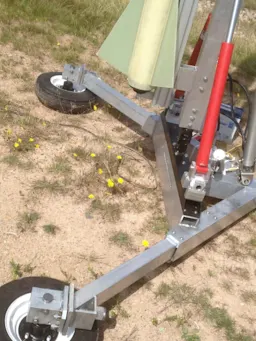
A: The bottom of the ramp is attached to a universal joint. A 2 in. bore x 24 in. stroke cylinder is used to lift the ramp. Lateral movement is done by 1-1/2 in. bore x 18 in. stroke cylinder. The assembly is towed, but sits on the wheels (from Princess Auto) which are used as side pads.
Q: What design/build challenges were overcome?
A: The lateral movements are passive (manual valves) and was difficult to remove air in it. The 2 in. bore cylinder is an air cylinder, and the pump needed to be adjusted to reduce pressure on seals. The lifting is done by a hydraulic pump, and that was relatively easy. But the side angle adjustment is done by simply using valves (passive). Getting the air completely out of the lines was a very big challenge. I ended up adding an accumulator which was pressurized and helps in keeping the 2 cylinders solid, if some air is still in the lines. Another problem was the pump pressure. For weight, I am using an air cylinder for the main lifting of the rail. At first, I did not change the pressure setting on the pump and did blow out the seals on the cylinder (body seal over the rod). I reduced the pump pressure for the down / return cycle and solved that problem. No issues after. The width of the pad is slightly larger than my enclosed trailer (5 ft wide), so I have to remove the wheels to load it into the trailer (calculation mistake!!). I can't easily fix this since everything is welded together now.
Q: If you had to build it again, what would you do differently?
A: It is continuously being modified. The 1-1/2 in. bore cylinders were steel, now replaced with air cylinders. Also, the wheels do extend to form 2 pads that support the launch pad. One of the future plans is to have small 1 in. air cylinders fitted to actually extend the legs automatically.
Q: Which Princess Auto location do you visit most?
A: Moncton, NB