Store selector: No store selected

“I am retired heat pump technician and I always like to build things. I take after my father who passed away at 100 years and 6 months, and worked in his shop until his last days. He started shopping at Princess Auto in the early fifties by catalogue and still had a 1954 catalogue, which he had brought to your Moncton store to check on a particular item. The catalogue generated quite the stir when the staff looked at the date on the cover… and no, the item was no longer available! He also was very creative with woodworking, as well as in metal forging, sawmill operation, lumbering, and able to build everything. I guess I’m a chip off the old block.”
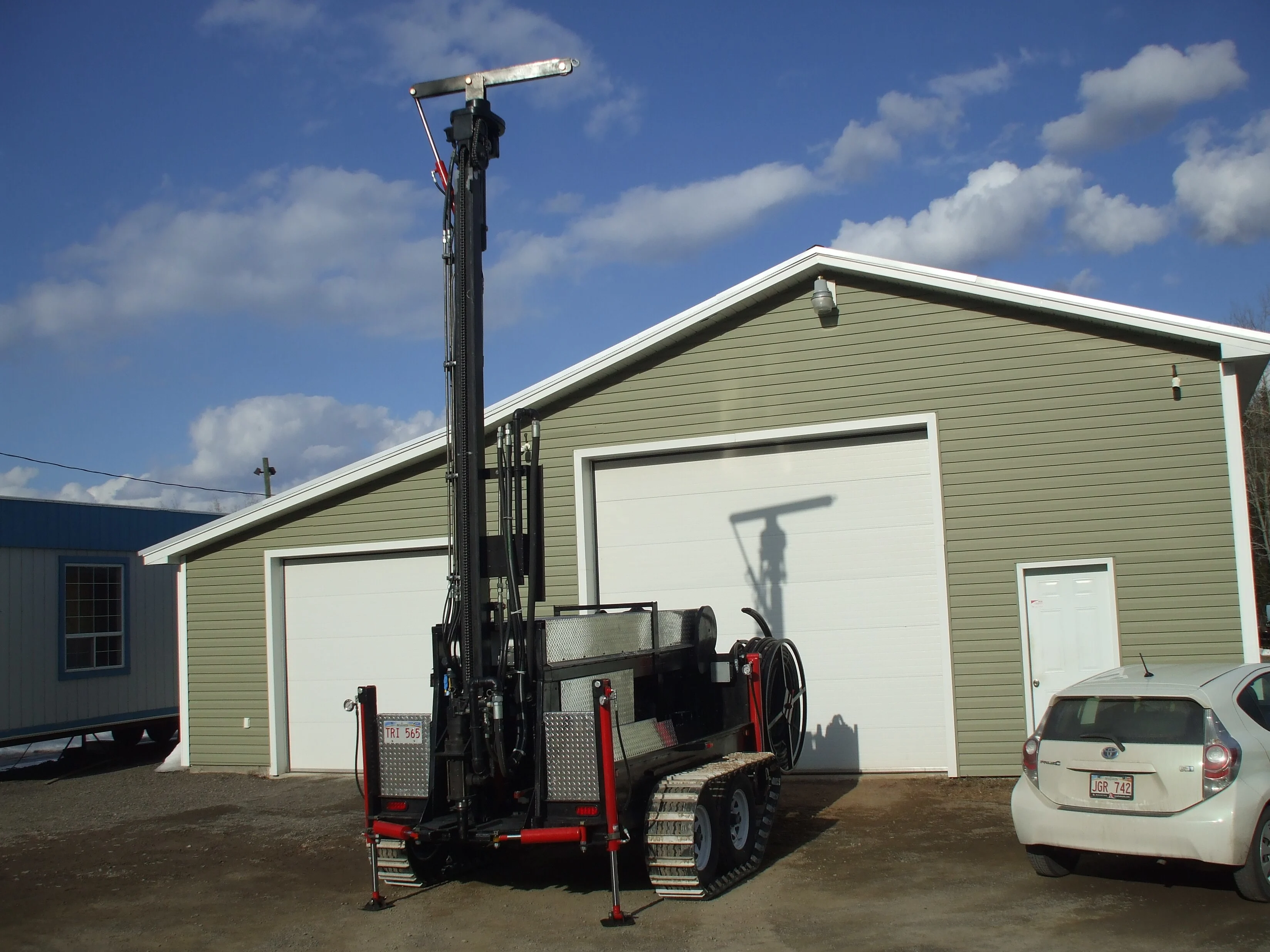
Some people have a remarkable talent for designing and building things for unique applications. Setting up a geothermal heating and cooling system is tricky enough as is, but this Geo Drill built from the ground up helps the installation process go much easier.
Fantastic project, Charles! Thanks for sharing it with us!
Q: What is it?
A: It’s a self-contained geothermal drill for making boreholes to insert ground loops used in energy efficient and green comfort systems. Can be used for any type of drilling, but is mainly set up for geothermal vertical ground loops.
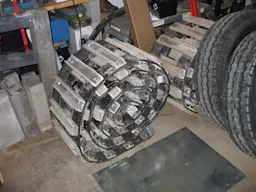
A: After I retired, I decided to build this project… and 2 years later, we tested it and it works excellent. It has a down pressure and pull back of 6,000 PSI, a head rotation torque of 1,000 foot-lbs, a head speed of 0 to 180 RPM, and can drill up to 6-inch holes using drag bites or depth hammer. It also has a removable track system and steering, so it is fully maneuverable on the job site using remote controls. It also has a tower crane to pick up casing, etc. It also has LED lighting to work after dark.
A: On a typical day we can drill 600 feet of bore holes and lower the loop pipe into the hole, which are installed using the two large reels (which are also hydraulic powered). The reels lower on the trailer hitch to load one 600 foot 1-inch loop of geothermal pipe on each side, which then lift up to the top were power rotation is used to unspool the pipe into the bore hole.
Q: What is the main power source for your project? (e.g. electric motor, gas engine etc.)
A: I built this using a 220 HP, 6-cylinder 5.9 Cummins industrial diesel engine, coupled to a 375 CFM Air End screw compressor on the back of the engine, along with 3 hydraulic pumps on the front end and a water injection pump. It also has pipe reels, which will hold two 600-foot coils. These reels are piped to the water pump through a water swivel, so by turning a valve you can fill your pipe to assist lowering into the borehole. This machine is capable of drilling depths down to 400 feet, and has a built-in 130-gallon water tank on the top to feed the onboard 4-cylinder Bean water injection pump. It can pump 22 gallons per minute up to 550 PSI, and inject water in the drill pipes. It is run by 1 of the 3 hydraulic pumps coupled to the front of the engine.
A: When drilling a borehole you need to inject water from the onboard water pump to cool your drill bit, and you need to supply air to blow out the tailing out of the hole. This is where the 375 CFM Air End screw compressor produces the air for that task.
Q: How do you control your project? (e.g. hydraulic control valve(s), electric switches etc.)
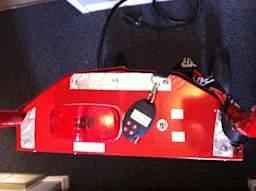
A: Mostly hydraulics. It has 17 hydraulic valves and 4 electric valves for wireless remote control drive system.
Q: What components are used to perform the work for your project? (e.g. hydraulic cylinder(s), hydraulic motor(s), sprockets, pulleys etc.)
A: On this rig there are 3 hydraulic pumps running 17 hydraulic spool valves, 7 hydraulic motors, 10 hydraulic cylinders and 2 pressure accumulators.
Q: What design/build challenges were overcome?
A: This drill measures 13.5 feet long including the pole, and 96 inches wide. It was built from scratch to be as compact as possible, so we can go into residential backyards as well as able to handle commercial jobsites.
Q: If you had to build it again, what would you do differently?
A: I would build it the same way, but now that I have every detail figured out, it would only take about half the time. Probably add one more foot to the trailer platform to have more room to mount my components.
Q: Which Princess Auto location do you visit most?
A: Moncton, NB