Store selector: No store selected

"I am a fourth class power engineer and run a boiler in my job. I have worked as an operator/plant manager for a number of years, and now work on taking care of all the maintenance and trouble shooting at the plant. I curl in the winter, and have a fairly well-equipped woodworking shop where I have done some projects such as grandfather clocks, entertainment centres, furniture etc. I haven't done much woodworking lately, but hope to get back into it when I retire."
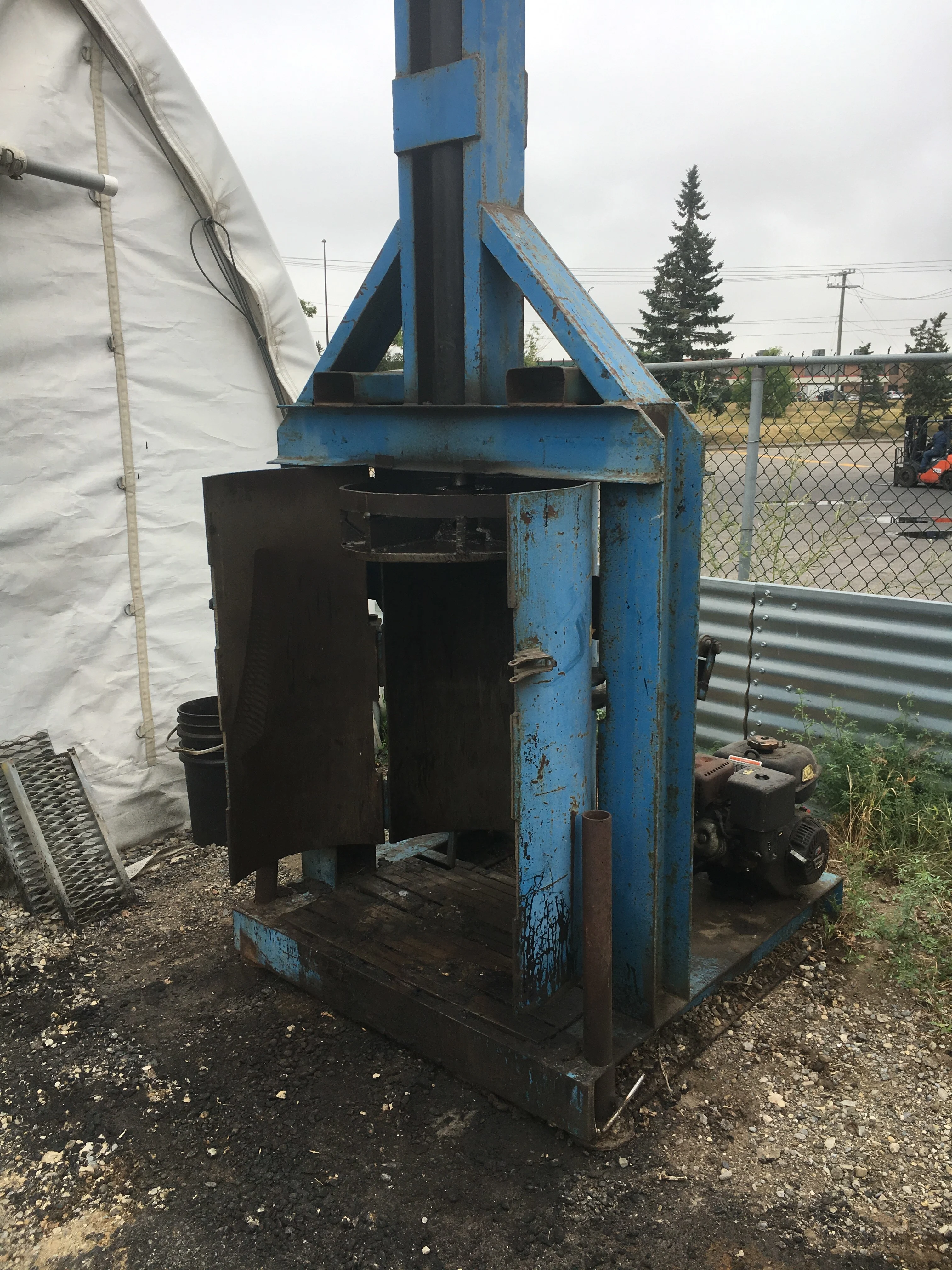
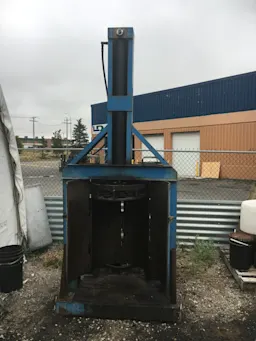
Dealing with an increasing number of empty 45 gallon drums is a problem that can very quickly eat up a lot of real estate. But turning lemons into lemonade requires a press... which is exactly the solution Miles had in mind for the multitude of unused drums populating the area around his work. A little ingenuity and a few components produced a machine capable of compressing those space-hogging freeloaders down to a more manageable size. As the saying goes: "Where there's a will, there's a way".
That's some serious crushing action. Thanks for sharing your project with us, Miles!
See it in actionhere
Q: What is it used for?
A: To crush empty 45 gallon drums into 4 to 5 inch high pancakes to reduce their size and make them into scrap metal. I was transferred with my job to Calgary in 1993 as a plant manager here. When I came here, we packaged a Rubberized Crack Filler in drums that had a bag liner inside. These drums were shipped to our customers, the product used, and the drums were sent back to us to be recycled and reused. Shortly after, the business changed to our shipping the product in bulk, so we ended up with a mountain of used drums. This crusher was what I designed and built to solve that problem. We still use the drum crusher today.
Q: What is the main power source for your project? (e.g. electric motor, gas engine etc.)
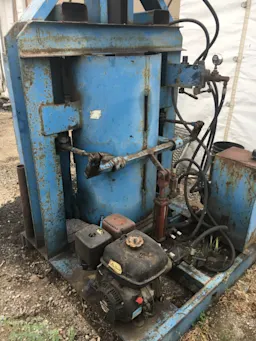
A: Gas engine to power a 2-stage hydraulic pump. Originally had a 11 HP Briggs & Stratton motor. It was electric start only, and had problems keeping the battery charged. I eventually replaced it with an engine with pull starter, purchased at Princess Auto.
Q: How do you control your project? (e.g. hydraulic control valve(s), electric switches etc.)
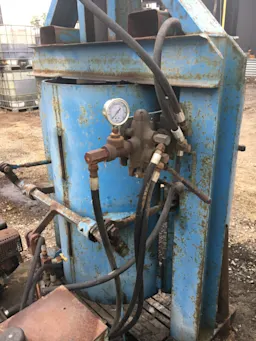
A: Two 2-way control valves are used to operate two double-acting hydraulic cylinders. The main cylinder is used to compress the drum into a biscuit, and the other operates the mechanism to open and close the clamshell doors.
Q: What components are used to perform the work for your project? (e.g. hydraulic cylinder(s), hydraulic motor(s), sprockets, pulleys etc.)
A: Hydraulic pump, hydraulic cylinders, hoses, control valves. All hydraulic components were purchased at Princess Auto. The cylinder I used is a 5 in. bore with about a 2-1/2 in. rod, and a 48 in. stroke. I used a 2-stage pump that is set to go at a higher volume up to about 600 PSI, then switches to a lower volume up to about 2,450 PSI. I am not exactly sure of the high volume pressure without seeing it work, but it is somewhere in the 600 to 900 PSI range. The pump is designed for an 8 HP gas engine for log splitters. By my math, the cylinder exerts about 48,000 lbs of force. The cylinder crushes the drum on the faster speed about 2/3 of the way, then switches to higher pressure/lower volume and continues up to 2,450 PSI until the drum is totally crushed, about 3 1/2 to 5 in. thick, depending on the gauge of the metal the drum is made of. We then put the crushed drum in a metal bin which goes for metal recycling.
Q: What design/build challenges were overcome?
A: I did have a couple of issues with it when I first built it. The bottom had to be strengthened as it started to bend from the force of the hydraulic cylinder. This was corrected by adding more structure to the bottom, which solved the problem. For safety reasons I designed a clamshell type of door to keep the drums contained while crushing them. The bung hole must be open or, for extra safety, a hole punched through the side of the drum with a pick axe to relieve pressure as the drum is crushed. The drum could potentially explode from the pressure if this is not done. That's the reason for the clam shell door on the front. To keep cost of build to a minimum, I purchased the metal at a scrap metal yard, so took a bit longer to acquire materials as what I needed was not always available.
Q: If you had to build it again, what would you do differently?
A: I have some ideas of how I would build it if I were to do it again. I would likely build it horizontally so it could be made to tow behind a vehicle. Even though it has been used for twenty plus years and crushed tens of thousands of drums, I would likely have to have proper mechanical drawings made and certified by a mechanical engineer to be acceptable for use in today's world. If one was to build it for commercial sale, it would have to be done. When this one was built, it was to solve a problem I had; proper drawings and certification would have driven the cost up for this "one-off" build.
Q: Which Princess Auto location do you visit most?
A: Calgary, AB (the south location)