Store selector: No store selected

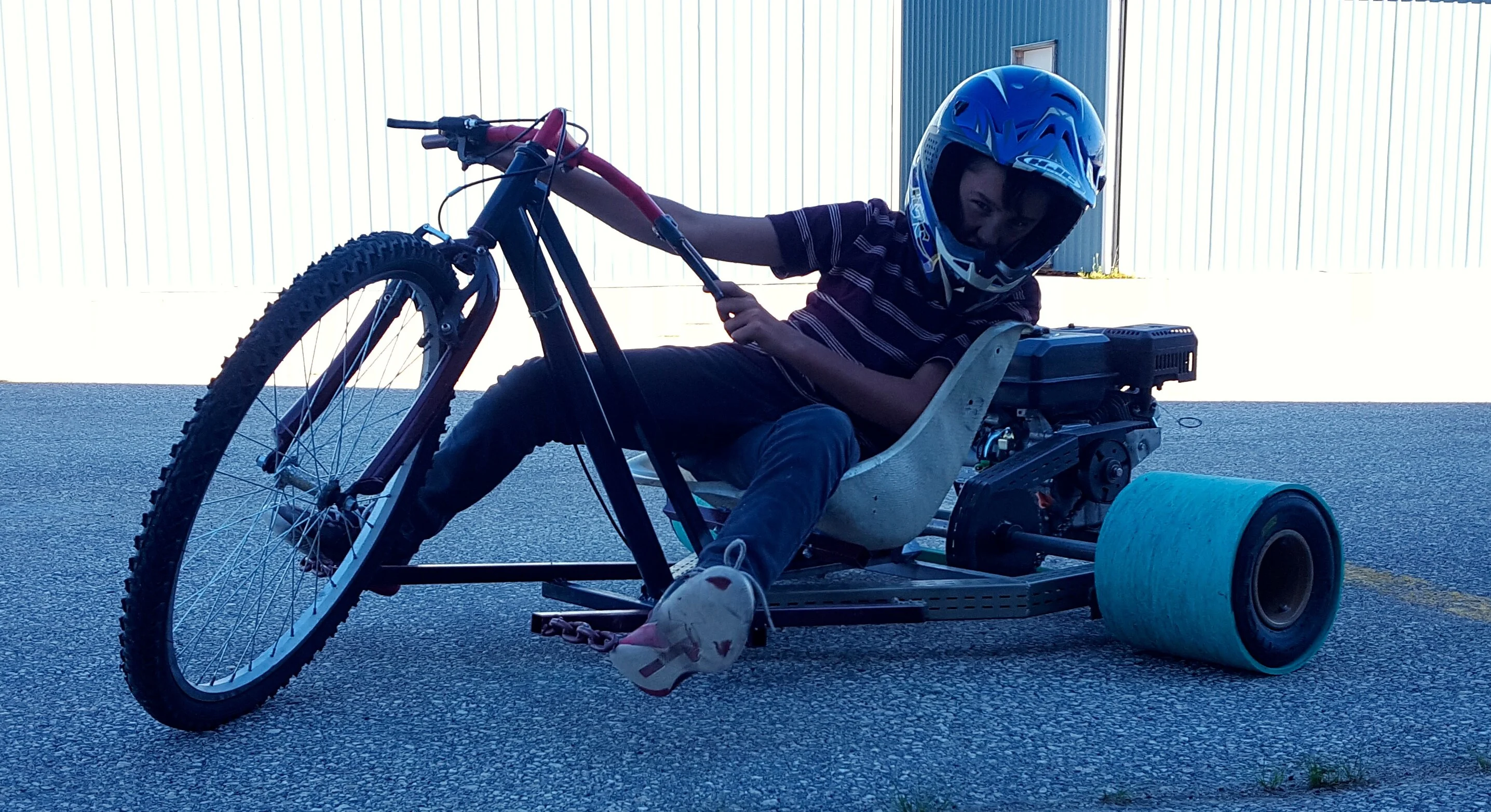
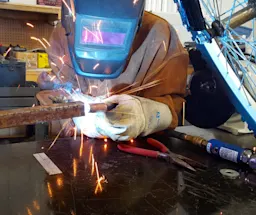
"I'm an Aircraft Maintenance Engineer by trade. I love to build, design and create. I find great satisfaction in troubleshooting problems and repairing things that are broken. I also enjoy taking anything apart (even if it's not broken) to see how it works and how it was made. For the last few years, I have made most of all my Christmas gifts by hand. I design and build functional art from old aircraft parts that are deemed scrap or are time expired. Matt is my friend's son, and he spends time at work with me helping repair and maintaining aircraft and other mechanical equipment.
I pass on knowledge and train apprentices on a regular basis. Matt has been fun to pass those skills to, as we share the same sense of humor and both like to drive anything that turns gas into noise. And what kid wouldn't want to build a drift trike at that age? I know I would!"
Back in the 1970's, the Big Wheel was a plastic, low-riding tricycle with a large front wheel (hence the name), and a very popular ride-on toy. Later versions featured a rear hand brake that allowed young riders to perform thrilling spin-outs and drift manoeuvres. Under Chris's guidance, Matt learned to build his very own gas-powered version from start to finish. It's a hands-on experience that will serve him well for years to come.
Great project, Chris and Matt! Thanks for sharing it with us!
See it in actionhere and here
Q: What is it?
Q: This was a "Winter Project" that turned into only a month-long project. Matt, who was 12 at the time, was asked: "If you could make or build anything, what would it be?" Out of all the things he listed we decided on building a Drift Cart. The decision was made and so the winter project started. The project was used not only to build a gas-powered toy, but to teach him how to plan, measure, design, prepare, weld, paint, and troubleshoot. I decided that he would do all the work and I would only show him how, then let him complete the task at hand. A lot of the training was focused on safety. The biggest obstacle for him was having the patience to spend the time to learn each skill while building the trike; this added a substantial amount of time onto the project. I kept the progress at a constant pace so there was appreciable change every day we worked on it. It was a hands-on process that gave him the skills necessary to complete the Drift Cart, and he now enjoys the benefit of his handiwork. Of course, the best part is driving sideways around corners and doing 360 degree turns in a straight line!
Q: What is the main power source for your project? (e.g. electric motor, gas engine etc.)
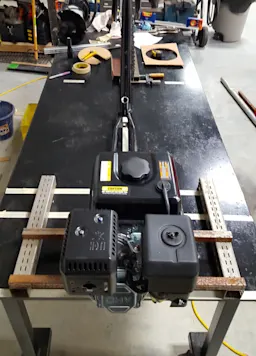
A: We used a 210cc (7 HP) engine. We initially asked around for a donor engine to keep the costs low, however after 4 donated engines the clutching / gearing arrangements and age / reliability proved to be limiting factors. Going with a new engine diverted the time and attention to focus on the original plan.
Q: How do you control your project? (e.g. hydraulic control valve(s), electric switches etc.)
A: The engine is controlled with a twist throttle on the handlebars and a remote kill switch. The forward frame comes from a recycled bike. We modified the handlebars by cutting and bending them backwards, and welding them into place so the turning range would be greater while still being able to hold both handles. We kept the cantilever brakes in place.
Q: What components are used to perform the work for your project? (e.g. hydraulic cylinder(s), hydraulic motor(s), sprockets, pulleys etc.)
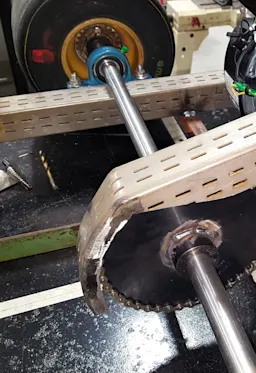
A: We used a gas engine with a centrifugal clutch to drive a sprocket attached to the axle. The idea was to use as much recycled material as possible. The frame, bike front end, clutch, seat, tire plastics and other small pieces were scrap, end cuts, and donations from friends and customers.
Q: What design/build challenges were overcome?
A: The design was not based on any drawings but referenced from pictures from other drift carts. This made the building process longer, as we had to not only figure out how to build it but how it needs to be built to make it functional, and have as few revisions as possible. There was a lot of fitting to figure out the best centre of gravity. We tried to keep the engine and the rider as close to the ground as possible to prevent a high centre of gravity and prevent tipping. The goal was to keep the front tire with enough weight to grip, but light enough to allow the ability to complete a 360 degree spin. A bigger challenge was figuring out the final gear ratio; how to use the clutch engagement RPM and the max engine RPM to get the best low-end torque and the highest max speed. It is a hard process as you need to have enough torque from the engine to break the wheels loose at a standstill, but enough RPM to spin the wheels faster than the speed of the cart during a drift. There was some math mixed with luck, and a surprisingly low amount of rework. Finding plastic for the wheels in the right size and availability was another challenge. We ended up first acquiring the rims and tires that were taken from a go cart. We did this first, as we needed a wide tire for a larger surface area for wear. Secondly, we needed a low friction sleeve for the outside of the tire. After searching, Green PVC pipe was the answer. The inside diameter was not perfect, but with the tire deflated and a little dish soap it could be shoehorned in and massaged into place. As it turned out, the PVC pipe does wear out fast and does crack. We have changed a set or two and learned that the plastic sleeve should be slightly wider than the tire. Reason being the tire exerts pressure trying to expand the pipe on the edge. Any chip or deep scratch on that edge caused a stress riser and ended up cracking in some manner. Extending it beyond the edge of the tire lowered the pressure on the edge and concentrated it towards the inside. The biggest issue we had after completion and test driving was finding a crack in the frame. We were running the cart through the grass and the standing water before we had plastic covered tires. There was a dip in the grass that stressed the joint between the bike and the frame. Broken or not, fun was still had even after being soaked from head to toe. Kids do seem to be attracted to puddles!
Q: If you had to build it again, what would you do differently?
A: Knowing now the building process and the proper balance, we would invest in a pipe bender, plasma cutter, and flange/ring roller, and tube notcher to make a sleek compact frame. The engine was a good size, however we would probably use a Comet Clutch to get a better range of final drive speeds next time or as an upgrade.
Q: Which Princess Auto location do you visit most?
A: I mainly shop at the Panet Rd (Winnipeg, MB) location while sipping the coffee and planning my next project.