Store selector: No store selected

“YEGCIDER is our hobby gone haywire. Our devotion to cider started with our passion for local food. We believe in learning where our food comes from, supporting local businesses, building community in our neighbourhood and city, and connecting with people who have knowledge to share. Nathan is a certified cidermaker through the Cider Institute of North America. First trained as a civil engineer, Nathan went back to study urban planning to get a better understanding of the human elements involved in city building. He brings his passion for community building and interest in combining both science and art to his cidermaking. Kristy is a Certified Cider Professional through the United States Association of Cider Makers. Kristy has taken part in sustainable living and community building initiatives all over the world and used her skills locally to teach food production and gardening skills in schools. By day, Kristy runs a marketing and communications consulting business but her true passion is YEGCIDER and all that it entails.”
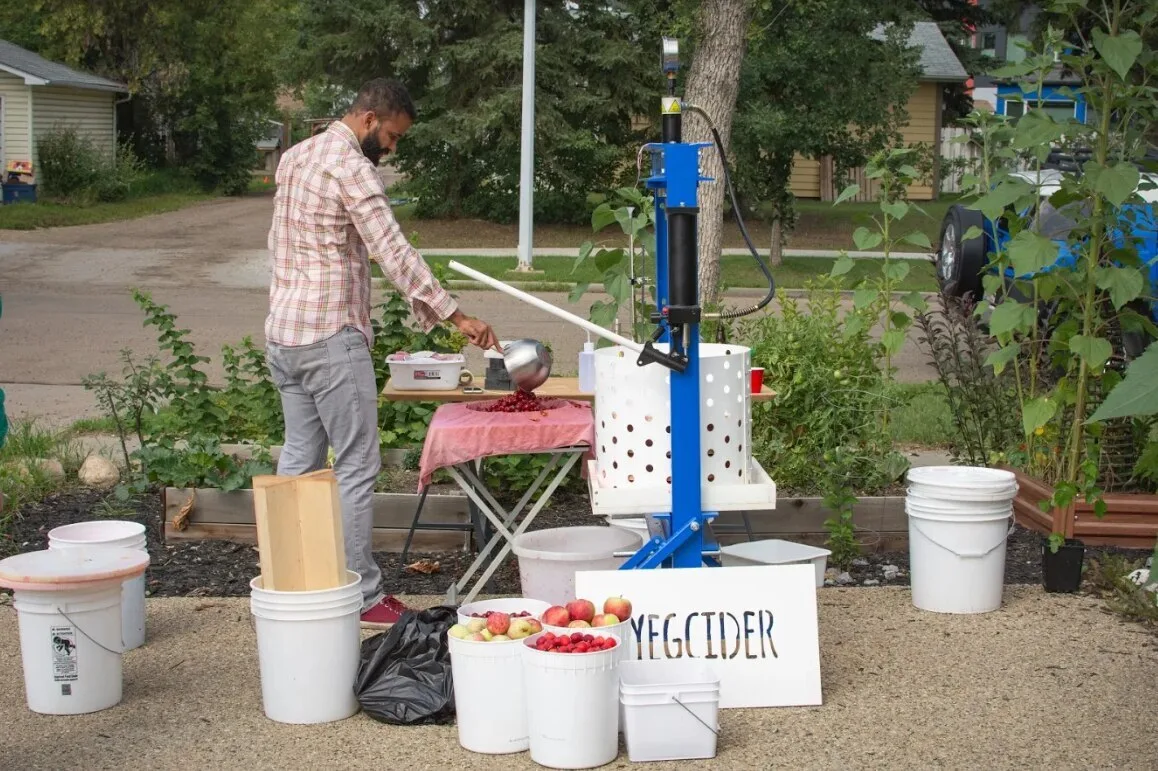
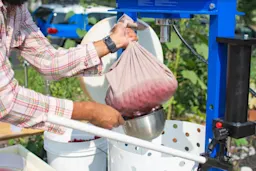
Fruit presses have taken many shapes over the centuries, but operating them required a fair bit of manual input. The earliest presses used large stone wheels that were pushed or pulled. The tub-style presses that came later either had top-mounted handles to turn, or flywheels to crank. Nathan and Kristy modified a hydraulic shop press to do all the pressing with less effort. No doubt it produces all the squeezing power they need to get every last drop! Great project, you two! Thanks for sharing it with us!
Q: Where did you get the idea of using a shop press for making cider?
A: Our press is an adaptation of a rack and cloth style press. If you start searching for inexpensive DIY alternatives for a cider press, you will come across this design. It’s popular with homebrew crowds so there are lots of forums online about how to design it.
Q: What press design/build challenges did you come across, and how were they overcome?
A: The planning and design took the most time, but the biggest challenge was making the trays, racks and basket to fit the press. We looked at a bunch of different ways to do it, but our friend Samantha had access to a plasma water table, and was able to cut those pieces out of food grade plastic. It was expensive and you need access to that technology, but it was worth it to have high quality parts to go with the shop press. She and Nathan worked on the design over a few weeks and then were able to build the press fairly quickly.
Q: If you had to build the press again, what would you do differently?
A: This size of press is hard to travel with. We definitely needed this size, but we want to build a smaller one to take with us for demos and community events. We added casters on the bottom to make it easier to move around.
Q: How many types of cider do you make?
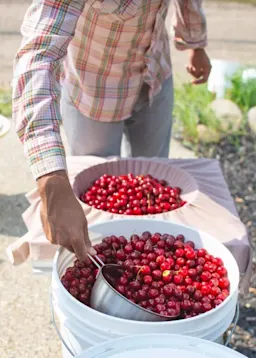
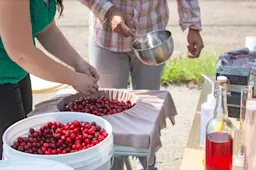
A: Our passion is to embrace local flavours of the prairies. That means using the fruit that grows here. Edmonton isn’t well known for its fruit production but there is actually a seemingly endless supply of apples in the backyards and public parks around the city. This year we collected over 10,000 lbs of apples; we were also able to collect a bumper crop of pears and will be making a pear cider or a perry. We also flavour ciders with whatever else we can forage from people’s yards or the river valley: rhubarb, raspberries, hops, currants, sage, sour cherries, saskatoons, pine, chokecherries, sea buckthorn, and highbush cranberries.
We asked people for feedback on our ciders this summer. The most well-received was our strawberry rhubarb. The least well-received was a cider made with sagebrush that we collected while camping in southern Alberta. People said it tasted like gravy. Part of the fun of experimenting is that sometimes ciders aren’t successful and you learn and do better!
One of the most interesting ciders we made this year we called Boreal Forest. It is a semi-dry cider with an aroma that you experience while hiking through the forest; flavours like spruce & pine build on a cider base. People either love it or hate it.
Q: After fruit is pressed and the juice collected, then what?
A: Once you have fresh pressed juice, if you just let it sit, it will usually make alcoholic cider. People who have never made cider before don’t need to be intimidated because it basically makes itself with the natural yeasts from the apples. You will end up with something drinkable that can even improve over time!
If you want to get a bit more involved there are a lot of other things you can do along the way. We like to tinker with the process to see how to make things better. Because we are working with local apples they are often tart and acidic. We balance that through blending a mixture of apples – some sweet, some tart, some bitter. This helps to balance the cider and make sure it tastes interesting. We also experiment with different kinds of yeasts to reduce the acidity.
We like to ferment slowly and at cooler temperatures. Not only do we feel like this embraces our local climate and seasons (we press in the fall and bottle in the spring!), but it also allows for the flavours to mellow a bit.
Q: What do you do with the by-product after pressing?
A: The by-product, called pomace, is great animal food! We have been able to donate some to a local potbelly pig rescue and some will be going to a local pork producer.
Q: Which Princess Auto location do you visit most?
A: Edmonton, AB