Store selector: No store selected

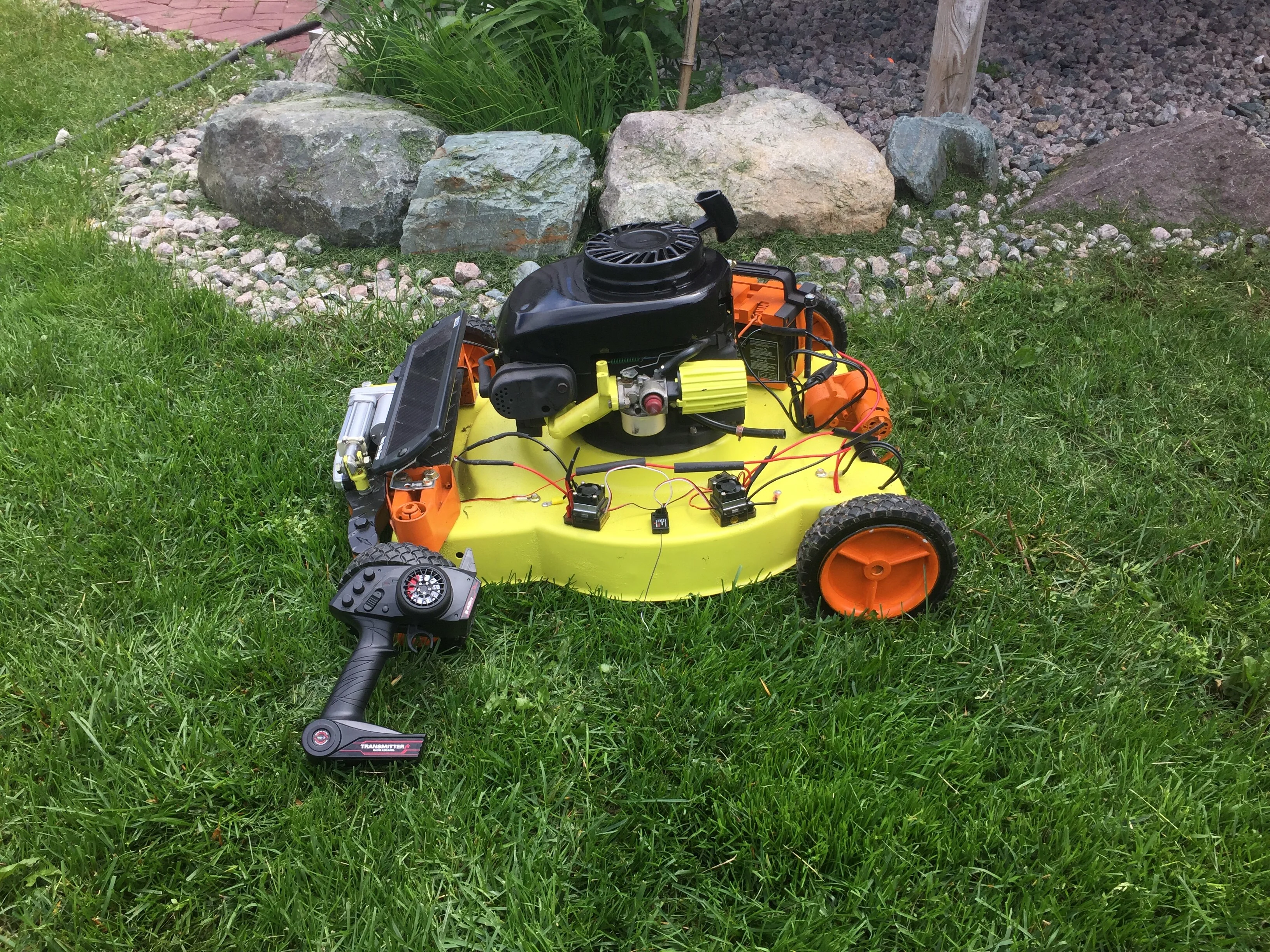
"I'm from a little town in Newfoundland called Harbour Grace. I am a 33 year old Civil Engineering Technologist, and I work as a Project Superintendent with a local construction company. I am married to my beautiful wife Maggie, and have a 3 year old girl named Audrey. I have many hobbies which include anything outdoors-related (fishing, hunting, ATVs, etc.). I love building things and creating new or improved projects. I shop Princess Auto all of the time for different things and most of the time it's where I get my inspiration. It's a place I can go if I get stuck with a design and then see a solution. 90% of my mower's parts were purchased from Princess Auto, and I wanted you guys to see what you inspire."
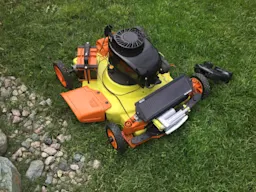
For some of us, cutting grass is as much fun as watching paint dry. A riding mower may make the chore semi-enjoyable, but a push mower still requires...well, pushing. A friend's comment was enough to get Ryan thinking about a new way to mow the lawn. With his background in engineering, this could this be the granddaddy of a fully robotic mower. After all, if we can get a robot to vacuum a house, why not cut the grass? Just as long as it doesn't take off on a rampage of National Lampoon proportions.
Great project, Ryan! Thanks for sharing it with us!
Watch the video to see how it controls (note: the gas tank was removed for storage purposes, so no grass cutting this time)
Q: What is it?
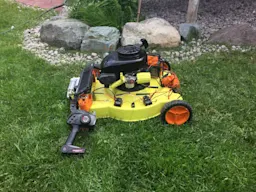
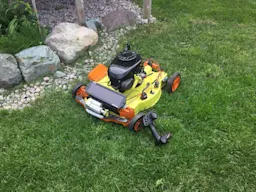
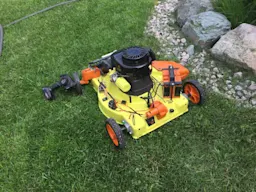
A: It's a Remote Controlled Lawnmower, with a solar-charged drivetrain. I got the idea when my friends and I were in my garage after I had just finished mowing my lawn. One of them asked why I didn't have a mower that was remote controlled (as a joke)... so I had to try!
Q: What is the main power source for your project? (e.g. electric motor, gas engine etc.)
A: The steering and drivetrain are powered electrically. Power comes from a 12V battery that's charged through an onboard solar panel. It also has a DC charging outlet for faster charging. The engine that runs the cutting blade is a standard vertical shaft 4-stroke gasoline engine. The drivetrain has an isolation switch for charging, and the gas engine has a momentary switch for safe operation.
Q: How do you control your project? (e.g. hydraulic control valve(s), electric switches etc.)
A: You control the whole unit with a wireless remote. The steering incorporates a 12V actuator that is directed by a variable speed controller. The drivetrain is driven by a worm gear directed by another variable speed controller. They are connected to a receiver that is controlled by the remote. You have to start the engine manually, and engage the switch to turn on the electronics.
Q: What components are used to perform the work for your project? (e.g. hydraulic cylinder(s), hydraulic motor(s), sprockets, pulleys etc.)
A: Live axel, worm gear, motors, electronic speed controllers, actuator, solar panel, gas engine, battery, illuminated rocker switches, remote control, and many pieces of hardware.
Q: What design/build challenges were overcome?
A: The design was completely unique, so it was all custom. I had to design the steering components to accommodate the actuators velocity. The live axel had to be in a position where it was safe to operate the mowers engine. The wiring schematic was a bit challenging trying to accommodate all of the mower's functions.
Q: Did you have a chance to actually use it over the summer? How did it perform?
A: It worked well! I have another idea to increase the cutting area back to its original size. I already increased the wheel size, which gives me more clearance from the ground. I can bend the mower blade around the drive gears to give a full cut.
Q: If you had to build it again, what would you do differently?
A: If I had to start the project over I would have installed the drive axel outside the frame. The reason is that I had to cut 2 inches off of the cutting blade to accommodate the worm gears without them colliding. This gives a smaller cut per pass. Also, maybe installing a high speed actuator for the steering could help. The motors use Electronic Speed Controllers, so if you're not used to its controls it can drive faster than it can turn! I would probably lower the steering and rear end, too. It requires 8 inch wheels to have enough clearance to cut grass!! But with bigger wheels, it travels a lot faster!
Q: Which Princess Auto location do you visit most?
A: St. John's NL