Store selector: No store selected

Tell us about yourself:“I’m a retired Projects Specialist, brought up in the automotive industry, engine reconditioning and machining.”
Cyclecars bridged the gap between motorcycles and motorcars between 1910 and the early 1920s. These “bare-bones” vehicles were inexpensive two-seaters the masses could afford, and simple to maintain. When advances in automotive technology after the First World War came along, cyclecars faded away. But the pleasure of driving vintage vehicles like these evolved into the exciting sport of Cyclekarting as we know it today.
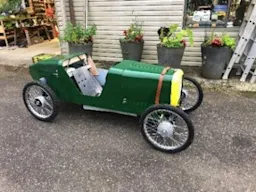
Cyclekarts are smaller, single-seat versions built purely for fun. Initiation into the world of cyclekarting requires that you to build your own (there are no ready-made plans or kits, and it’s considered a rite-of-passage to figure things out for yourself). Clubs organize races on dirt tracks and paved roads, but the emphasis is largely on the creation of eye-catching, vintage-styled karts, rather than winning races. After watching the video clip, we have no doubts that riding a “grown up go-kart” must be an absolute joy!
Looks great, James! Thanks for sharing your project with us!
See it in action: https://youtu.be/M2T3fluIiz4
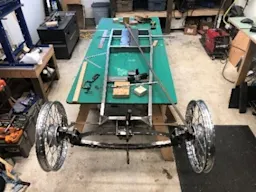
What is it? It’s a scaled-down representation of the 1900's era first sports cars or racing cars. It was modelled after a 1923 Austin 7, of which 3 were built to compete in auto races in England and France (all three cars won). Built strictly on the lines of an Austin 7 at about 2/3 full size, using both new and re-used materials. It’s basically a re-creation of how builder sees the original car.
There are several events where these CK's are 'raced'. In the past, there were two events in British Columbia, which were a huge success. There is a worldwide group of enthusiast of this hobby, and all enjoy gathering and 'racing' these little machines, just like the days of old. Speed is not great, around 45 km/h max, so safety is high. We do however, wear full protective gear.
What is the main power source for your project? (e.g. electric motor, gas engine etc.) It’s powered by a 212cc, 4-stroke OHV engine with TAV transmission, and the brake system is generally a disc type (either mechanical or hydraulic). The 17 in. wheels are from a Honda CT-100 bike.
The widely accepted engine is the Honda GX-200, or any one of the clones out there. At 6.5 HP, these little engines are ideal. Slight modifications are allowed but to stay in the guidelines these are limited. We remove the low oil shutdown and the governor. The standard exhaust is removed and replaced with a straight pipe and small muffler. A better, free flow air-filter is also part of this modification. There is no clutch, as this is carried out by the CVT.
How do you control your project? (e.g. hydraulic control valve(s), electric switches etc.) The standard Go-Kart type controls are used. Mechanical brakes have a direct rod to the disc brake caliper lever. If hydraulic brakes are used, the brake pedal and master cylinder are connected via hose or steel line to the caliper. The engine must have a kill switch; this is taken off the engine and mounted on the dash.
What components are used to perform the work for your project? (e.g. hydraulic cylinder(s), hydraulic motor(s), sprockets, pulleys etc.) The 1-inch rear axle, bearings, sprocket, disc brake and most hardware came from Princess Auto. The work to build this project mostly involved hand tools, an angle grinder, a drill press, and a wire welder (I used flux core wire). I also have a hydraulic press that was a great help in forming some parts.
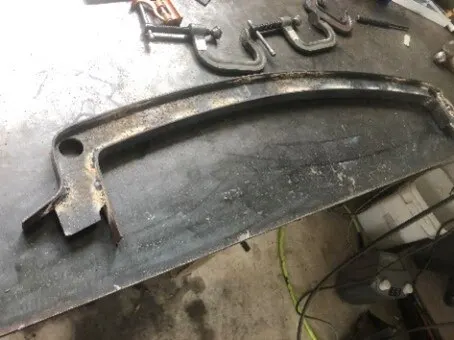
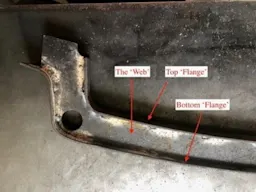
What design/build challenges did you overcome? The biggest challenge was the front axle; I wanted it to be a direct copy of the original car. It was fully fabricated from a waterjet cut main spine with top and bottom flat sections fully welded on. This required some scale drawing and fiddling to get the 'right look' and still be strong. I had the main web waterjet cut from 3/16 in. plate and used 1 in. x 1/8 in. flat bar as the top and bottom to form the "I" beam. The rest of the build was pretty straightforward. The spindles and kingpins were all fabricated, as there were none available.
If you had to build it again, what would you do differently? I think next time I will follow much the same path but refine the suspension, brakes and the chassis design. The main thing I would change is how I did the bodywork. I used some fairly weathered plywood, which did not take paint too well, and it was 'heavy' at 1/4 in.; next time, I would use 1/8 in. plywood, or learn how to form aluminium and skin the body that way.
Which Princess Auto location do you visit most? Langley, BC