Store selector: No store selected

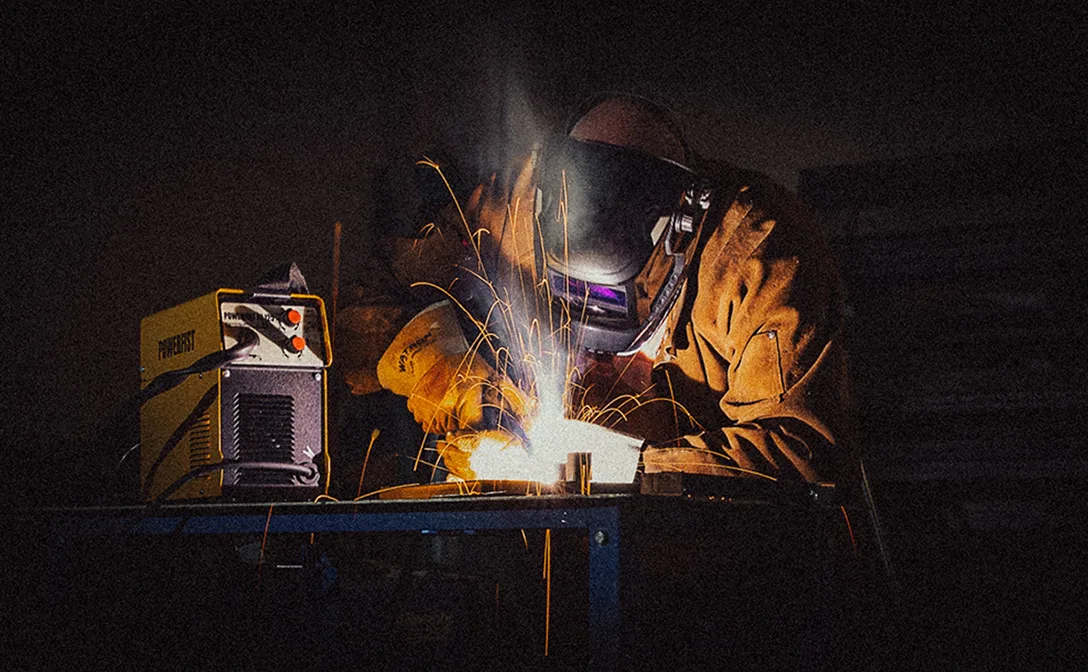
Welding is one of the strongest and most reliable methods for joining metals. This guide will help you understand the welding process, compare methods, and choose the right welder for your needs.
Welding is a process for joining or fastening two pieces of similar metals (workpieces) by melting and fusing 1) the base metals being joined and 2) the filler metal applied. Workpieces are welded together by applying extreme heat, resulting in melting both pieces and the filler metal (rod/wire) to a molten state that cools to form a strong joint. The energy to form the joint between metal workpieces most often comes from a flame (e.g. oxy-acetylene) or an electric arc. Most welding involves ferrous-based metals such as steel and stainless steel. Welding covers a temperature range of 815 to 1,649°C (1,500 to 3,000°F), and is the strongest method for bonding metal to metal. Welding can also be done without the use of a filler metal, by using heat energy alone.
Consider the most common uses and applications for your welder: construction, farm/ranch, general maintenance/repair, home, autobody repair, etc. Welders are designed for certain applications, depending on rated output, duty cycle and other features. For example, aluminum repairs require either a heavy duty MIG welder with a spool gun, or a TIG welder that can handle different types and sizes (thickness) of metal. Repairing a wrought iron railing can be done using just a stick welder.
What power is available? Do you have 230V power in your garage or workshop? If not, you will have to limit yourself to a 115V welder. If electrical hook-up is not available, a gas-powered welding generator can supply welding and auxiliary power. How thick is your base metal? The thicker the material, the more powerful the welding machine you will need. See the chart guidelines (pages 9-10).
How much will you use your welder? If you plan to use your welder for long sessions, you should choose one with a high duty cycle. This will allow you to weld for longer periods before the machine needs to stop and cool down. Duty cycle is a rating that indicates how many minutes, out of ten, that a welder can produce its maximum output without overheating.
What materials will you be welding? Remember that flux-core wire and most small rods for 115V stick welders only work on mild steel. If you plan on welding aluminum or stainless steel, you must buy a mIG or 230V arc (stick) welder. 230V arc welders can also weld with other specialty rods such as cast iron, hard facing, cutting, and machinable rods.
Welding skill level: moderate This process uses a consumable electrode to support the arc. Shielding is achieved by the melting of the outer flux coating on the electrode. Filler metal is obtained from the electrode core.
Good for windy, outdoor conditions
OK to use on dirty or rusty metal
Recommended metal:
Steel, stainless steel, cast iron
Standard Arc Welding Rods
E6011 - easy to use all-purpose rod with good penetration, even with dirty base metal - mild and medium carbon steels
E6013 - general purpose all-position rod with low spatter produces a better, cleaner weld
E7014 - all-position rod with a high deposition rate for faster welding
E7018 - low hydrogen rod produces tough, high strength welds
Required Equipment:
Welding helmets
Leather gloves/protective clothing
Electrodes: rods
Welding skill level: low to moderate A process used with a wire-fed welding machine. Metals are joined by heating them with an arc, which is between the continuously fed filler metal electrode (solid wire) and the workpiece. Externally supplied gas or gas mixture provide shielding.
Easy process to learn
Better control on thinner metals
Cleaner welds with less slag to clean
Equipment can be used for flux-cored welding
Recommended metal:
Steel, stainless steel, aluminum, cast iron
MIG Wire MIG wire requires different shielding gases depending on the type of wire being used. Most MIG wires are available in 0.024 in., 0.030 in. and 0.035 in. diameters.
E70S - mild steel MIG Wire - 75% Argon, 25% CO2
E316 - stainless steel MIG Wire - 75% Argon, 25% CO2
E4043 - aluminum MIG Wire - 100% Argon
Required Equipment:
Welding helmets
Leather gloves
Electrodes: rods, flux-cored wire or MIG wire
Gas hose
Gas regulator
MIG shielding gas
Welding skill level: low A process that uses a wire-fed welding machine. Metals are melted and joined by heating them with an arc between a continuous, consumable electrode wire and the workpiece. The weld is tubular with flux material contained inside the shielding. Added shielding may or may not be supplied from external gas or gas mixture, depending on the type of flux-cored wire being used.
Works well on dirty or rusty material
Deep penetration for welding thick sections
Can be used with or without shielding gas
Self-shielded wire is best for outdoors and windy conditions
Flux-cored wire produces shielding gas when the flux inside the wire melts
Recommended metal:
Steel, stainless steel
Standard Flux Core Wire
E71T- flux-cored wire is available in 0.030 and 0.035 diameters
Required Equipment:
Welding helmets
Leather gloves/protective clothing
Electrodes: flux-cored wire
Welding skill level: high This process uses welding equipment with a high-frequency generator. The arc is created between a non-consumable tungsten electrode and the workpiece. Filler metal may or may not be used, and argon inert gas or inert gas mixtures are used for shielding.
Provides high-quality, precise welds
Highly aesthetic weld beads
Recommended metal:
(AC TIG): Aluminum, magnesium alloys, (DC TIG): Steel, stainless steel, copper, brass, and titanium
Standard TIG welding rods
EWTh-2 - All-purpose rod for welding steel and stainless steel
EWCe-2 - General-purpose rod for low amperage welding
Required Equipment:
Welding helmets
Leather gloves/protective clothing
Electrodes: TIG rods, tungsten rods
Gas hose
Gas regulator
TIG gas (typically pure argon or an argon mix) shielding gas
Optional foot pedal
A welder that does more than one process. Some do TIG, stick, and MIG, while others do TIG and stick. Multi-process welders offer you the most bang for your buck and they don’t compromise on power. Ideal for the hobbyist, do-it-yourselfer, or small contractor who wants to do MIG welding and more, including stick, TIG and flux-cored welding. An efficient and easy way to have all common welding processes in one compact unit. Great for all skill levels as the machines are extremely user friendly and can do the whole range from simple to advanced welds.
All Pro.Point welders are inverter welders Traditional welders use electrical transformers to distribute the current, but inverter welders use computerized circuit board technology to efficiently amplify and distribute input energy to produce the desired welding current. The input is AC current, but the output is DC current to achieve a better weld. Inverter technology allows for lighter, smaller machines, with more power and better efficiency. A superior technology that is typically slightly more costly than a traditional welder, but well worth the investment.
Welding skill level: low Two separate pieces of metal are joined by passing a current between electrodes positioned on opposite sides of the workpieces. No arc is used; rather, it is the resistance of the metal to the current flow that fuses the pieces.
Portable and easy to operate
Ideal for light industrial applications
Recommended metal:
Steel, stainless steel
Required Equipment:
Welding helmet or welding goggles
Leather gloves/protective clothing
Welding skill level: low to moderate Oxy-acetylene torch outfits use oxygen and acetylene gas to create a portable heat source. They can be used for welding, brazing and cutting.
Welding and Brazing Welding or brazing rods are melted by the oxy-acetylene torch to create strong metal bonds. One advantage of brazing is that a wide variety of metals can be joined with theis process including: brass, copper, bronze, aluminum and chrome-plated metal. Also, brazing can be done at a lower temperature than welding, which reduces the risk of warping the base metal.
Cutting Torch cutting is very useful, especially when cutting elaborate shapes not suitable for cutting with a band saw. Only metals that can rust, or be oxidized (typically steel) can be cut with a cutting torch.Required Equipment:
Goggles (shade # 5 lens)
Leather gloves/protective clothing
Oxygen gas tank
Acetylene gas tank
Oxygen and acetylene gas regulators
Double line hose
Brazing and welding only
Brazing or welding rods
Brazing flux (for uncoated rods)
Arc [Arc Length]
- The physical gap between the end of the electrode, and the point where the arc makes contact with the base metal.
Brazing
- A group of welding processes in which a groove, fillet, lap, or flange joint is bonded by using a non-ferrous filler metal having a melting point above 427°C (800°F), but below that of the base metals. Filler metal is distributed in the joint by capillary attraction.
Braze Welding
- A method of welding by using a filler metal that liquefies above 450°C (842°F) and below the solid state of the base metals. Unlike brazing, the filler metal in braze welding is not distributed in the joint by capillary action.
Butt Welds
- A welding technique where two pieces of metal are joined in the same plane.
Chamfer
- A transitional edge, usually at a 45° angle. Also known as a bevel.
Duty Cycle
- The time per weld out of a 1-minute period that an arc welder can be operated at maximum rated output. For example, a 60% duty cycle @ 300A means that the welding machine can weld for 36 seconds (at 300A) and then must be allowed to cool with the fan running for 24 seconds. This reduces the chance of heat damage to the system.
Electrode
- A coated metal wire having the same composition as the material being welded. It can be of stick or wire spool type.
Electric Arc
- Electrical conduction that occurs when a strong current jumps a gap in a circuit.
Fillet Weld
- Joins two surfaces at an approximate right angle to each other. There are several types of fillet weld.
Filler Metal
- A metal added in the making of a joint through welding, brazing, or soldering. Four types of filler metals exist –covered electrodes, bare electrode wire or rod, tubular electrode wire, and welding fluxes.
Flux
- The coating on arc welding rods and in flux-cored welding wire that is consumed in the arc to produce a shielding gas. The gas displaces air and impurities from around the weld.
Groove Weld
- A weld between the existing preformed grooves in pieces being joined.
Ground Lead / Workpiece Lead
- The conductor cable or electrical conductor between the arc welding machine and the work.
Non-Ferrous Metals
- Any metal, including alloys, that does not contain iron in appreciable amounts. Generally more expensive than ferrous metals.
Polarity
- Polarity is the direction electric current flow. With straight (DC-) polarity, heat is greater at the workpiece, which increases penetration. With reverse polarity (DC+) heat is greater at the electrode, which provides a steadier arc. Reverse polarity is better for making out-of-position welds.
Rated Output
- The amperage and voltage the power source will produce for a given duty cycle period. For example, 300A, 32 load volts @ 60% duty cycle.
Shielded Gas
- Protective gas used to prevent atmospheric contamination of the weld pool. Usually a mixed gas or C02.
Slag
- A layer of flux soot protecting the weld from oxides and other contaminants while the weld is solidifying (cooling). Slag is to be removed after cooling.
Spatter
- Metal particles thrown from the weld. often cooling and hardening on the work surface. A spatter-resistant spray applied to the workpiece can minimize spatter.
Torch
- A device in the TIG process to control the position of the electrode, to transfer urrent to the arc and to direct the flow of shielding gas.
Tungsten
- A rare metallic element with extremely high melting point used for manufacturing TIG electrodes.
Welding Position
- All welding can be classified according to the position of the workpiece, or the position of the welded joint on the plates or sections being welded. Some welding processes have all-position capabilities, while others may be used in only one or two positions. The 4 basic weld positions are: flat, horizontal, vertical, and overhead.
Wire Feed
- Motor driven deck which feeds welding wire through the welding nozzle.
Wire Feed Speed
- Expressed as in./min. or mm/sec, and refers to the speed and amount of filler metal fed into a weld. The higher the wire feed speed, the higher the amperage.