Store selector: No store selected

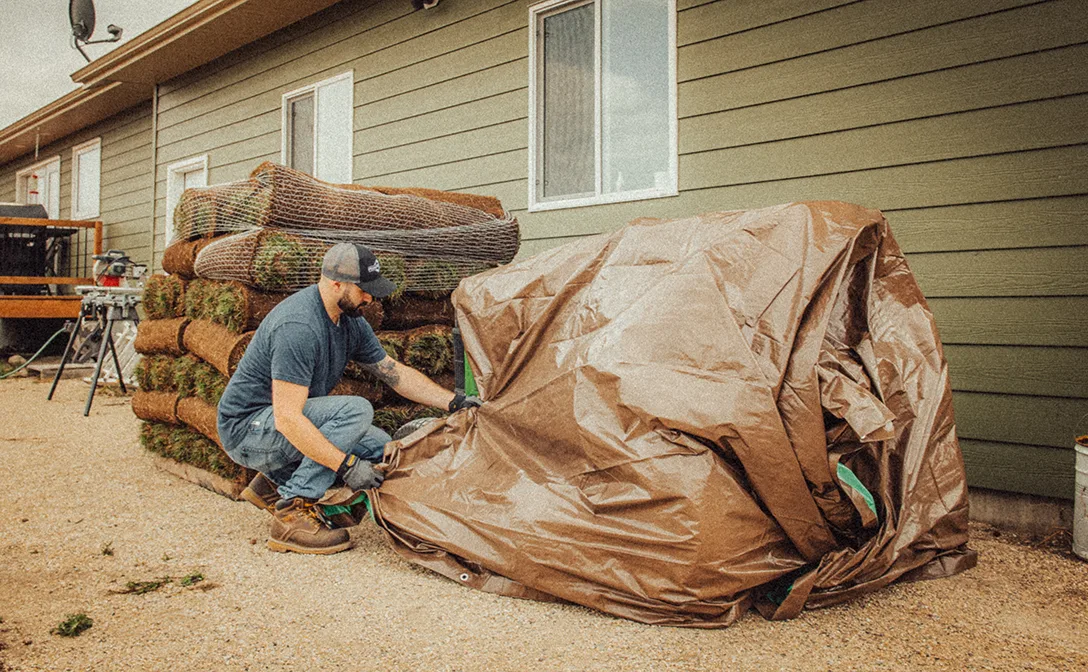
Find the best tarp for your job—whether for camping, covering tools, protecting hay, or insulating in winter. Compare poly, canvas, insulated & heavy-duty tarps by Powerfist.
Canvas tarps are strong and sturdy. Although they’re made from a porous material that offers a non-slip surface, they aren’t waterproof. However, canvas can be coated to resist water and/or flame; the material remains breathable, ensuring that too much heat or condensation isn’t trapped during use.
Canvas tarps are ideal for covering equipment and tools during storage, protecting cargo during transportation, as well as protecting floors during painting jobs.
Poly tarps are strong enough for most jobs, including protecting cargo during transportation and outdoor equipment during storage. They’re also useful for agricultural and industrial applications such as acting as a cover for auto and recreation vehicles, greenhouse cover, pond or compost-bin liner and as a grain and bale cover. As well, they’re fantastic for storage and yard work – some have a drawstring so you can use them to easily gather leaves and yard waste.
Insulated tarps are used to keep cold out and heat in, so they’re ideal for use as a protective wrap. They often feature a UV-resistant coating to guard against damage from the sun, as well as grommets that accommodate cords or bungees when using them as a protective wrap.
Industrial duty tarps are ideal for farms, garages, boatyards and more. They offer stronger weight and mesh than all-purpose tarps, so they provide dependable long-lasting use.
Consider the type of environment where you’ll need your tarp. If its main use is for outdoors, use one that’s UV resistant.
Remember: Some tarps are waterproof. In addition, tarps made with polyethylene are ideal for resisting water and also most chemicals.
Mil thickness: Tarp thickness is measured in mils, where 1 mil is equal to 1/1,000 of an inch. The larger the mil thickness, the thicker the tarp. Lightweight tarps are between 5 and 6 mils. Heavy-duty tarps are 20 mils and thicker.
Denier: Denier is the measure of the thread weight, or grams per 9,000 ft of thread, that is used to make a tarp’s mesh (or scrim). The larger the denier, the more the tarp resists wear and tear.
Grommets: Grommets are the small metal rings used to reinforce holes in tarps, and they’re usually made of brass, stainless steel or aluminum. They can be inserted into the corners and edges of tarps that are designed to be tied down, so they’re used to accommodate the attachment of cords or bungees to the tarp.
MOX Tear and waterproof MOX film is a multi-layer, multi-axis-oriented cross laminated material, which is comprised of layers of film bonded to one another in the machine-operating direction, transverse and angular axis — all together in 16 directions. They’re bonded by a cold-rolled technique, making them stronger than standard tarps.
PVC has good durability and is heavier and stronger than polyethylene, so tarps made with PVC are commonly used as coverings and for agricultural and industrial use.
Polyethylene is harder than PVC, making it more resistant to tearing. It also has better waterproofing ability than PVC, through its ability to withstand water and most chemicals. Poly tarps offer exceptional durability and use in damp conditions.
Some tarps feature a UV-resistant coating for protecting against damage from the sun. As well, many tarps that are made to cover haystacks are designed specifically for outdoor use: they feature silver on the outside to reflect light and black on the inside to prevent greenhousing.
When you see a weave measurement, e.g., 8 x 8 in., it refers to the density or thread count of the tarp's weave pattern. The first number indicates the number of warp threads (i.e., vertical threads), while the second number represents the number of weft threads (i.e., horizontal threads).
Higher numbers mean a denser weave! In other words, a tarp with a 16 x 16 in. weave has twice as many threads per inch as a tarp with an 8 x 8 in. weave. This affects the tarp's overall strength, durability and resistance to tears.
Greater Strength: Tarps with higher weave densities are generally stronger and better able to withstand rough conditions compared to tarps with lower weave densities. They can handle more tension and strain without tearing compared to their low-weave-density counterparts.
Enhanced Protection: A dense weave means smaller gaps between the threads (unlike low-weave-density tarps), resulting in improved resistance against wind, rain and even UV rays. It offers enhanced coverage and protection for your precious cargo.
Thicker Appearance: As the weave density increases, the tarp tends to become thicker and more substantial in feel. This can provide additional sturdiness and longevity.
Fun Fact: The thread count doesn't necessarily indicate the thickness or weight of the tarp material; it primarily reflects the density of the weave pattern!
Choosing the Right Weave: Now that you understand the significance of these numbers, you can make an informed choice when selecting a tarp. If you require maximum strength and durability, opt for a high-density weave, e.g., 12 x 12 in. or 16 x 16 in. For light-duty applications, an 8 x 8 in. or 10 x 10 in. weave might suffice.
Understanding these numbers empowers you to make smarter choices and find the perfect tarp for your needs!