Store selector: No store selected

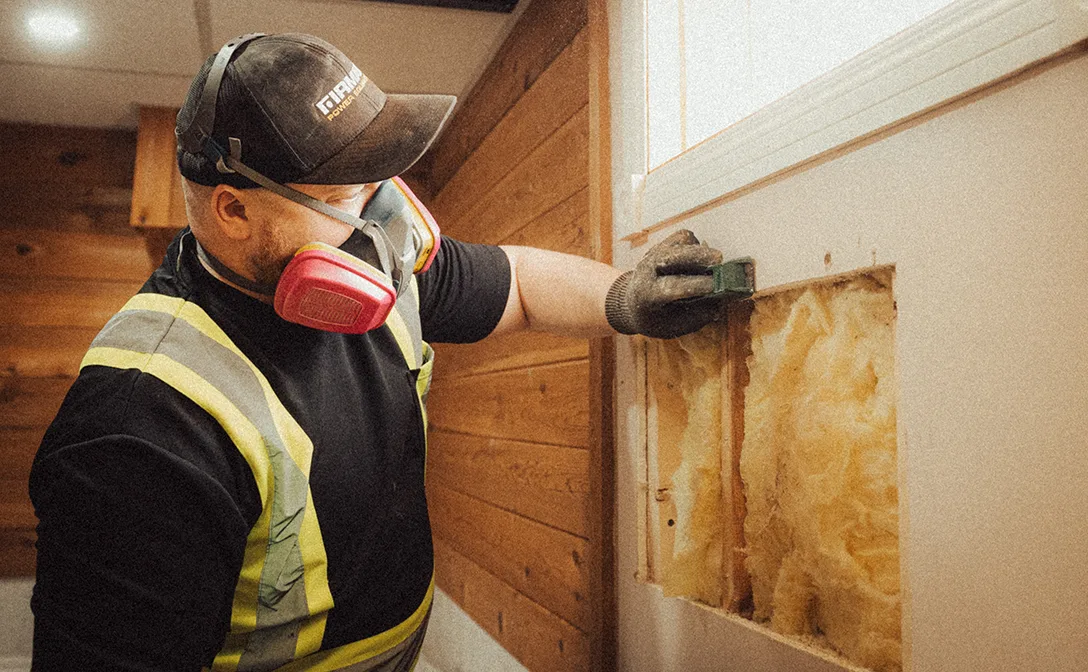
From dust masks and respirators to safety glasses and hearing protection, this guide helps you choose the right PPE for your job. Learn what gear to wear and why it matters — whether you’re on a job site or working at home.
Personal Protective Equipment (PPE) helps protect you from dangers. These dangers include loud noise, dust in the air, sharp objects, extreme heat or cold, and falling or flying debris.
When used with proper ventilation, a good-fitting dust mask or respirator is an effective way to protect your lungs (and your health) from all kinds of nasty airborne stuff when working on projects around the home or on the job.
Respirators and Particulate Filters (dust masks) are not the same thing, and selecting the right one for the job can be a bit confusing. All dust masks and cartridges are rated by the National Institute of Occupational Safety and Health (NIOSH) according to what, and how much, they filter out. NIOSH ratings are typically identified by a letter and number:
N: Not oil proof
R: Oil resistant (up to 8 hours)
P: Oil proof (beyond 8 hours)
The numbers 95, 97, or 100 next to the letter corresponds to the percentage of one-micrometer particles removed during clinical tests. Filters rated 100 are considered High-Efficiency filters (N100, HE or HEPA) and are tested against aerosol droplets 0.3 microns in diameter.
The most common rating for disposable dust masks is N95, which means it will filter 95% of airborne particles that are not oil-based. A mask rated at N95 will protect you from woodshop dust, allergens, and airborne diseases. Filters for painting are often rated R95, or higher to handle oil-based particles. If you’re looking for the highest level of protection in the widest variety of situations, go for P100, which will filter out 100% of both oil-based and non-oil-based particles.
Particulate filters are made of material that traps particles as you breathe. These masks are simple in design, disposable and may feature an exhalation valve (this helps keep your face cool while reducing humidity build-up). They cover your nose and mouth to provide protection from dust, mists, liquids, and some fumes – but not gases or vapors.
Chemical cartridge respirators are bulkier in design and contain a special carbon filtering material designed to absorb airborne gases and vapors. This is the protection you want when handling pesticides, fertilizers, solvent welding or gluing, and spray-painting enamels and lacquers. The replaceable cartridges are fixed on a half-mask (covering only your nose and mouth) or full-face (for protection against chemicals that can irritate your eyes and skin).
With impact resistant lenses, safety glasses are intended to shield the eyes from a variety of impact hazards such as flying fragments, objects, large chips and particles of debris. Frames of safety glasses often provide heat resistance, are far stronger than regular eyeglasses and are designed to prevent lenses from being pushed into the eyes. Dark or mirrored lenses are not suitable whenever eye contact between people is a job requirement.
Clear: Standard lens for indoor or low light conditions
Amber: Enhances available light for low light conditions
Indoor/Outdoor: Reduce glaring light without color distortion or dimming as a gray lens might cause
Smoked: The perfect all-around tint for standard shading in normal light conditions
Smoked Mirror: Similar to Smoked, but with a mirror lens coating which reflects more light, making it ideal for bright light conditions
Blue Mirror: Similar to Smoked Mirror, but has more reflecting power
Polarized Smoked: Perfect all-around tint for shading in normal light conditions while reducing harmful glare from reflective surfaces
Head injuries happen in a variety of ways; falling objects, flying projectiles, low clearance heights and electrical contact pose serious risks that can result in more than a headache. But not all hard hats are created equal. The Canadian Standards Association (CSA) prepared a series of tests to classify them according to their level of protection. Hard hats must be worn properly to be effective.
Intended to protect the user against vertical impact and penetration. Often used in environments where NO lateral impact hazards exist.
Intended to protect the user against both vertical/lateral impact and penetration.
A rigid shell that resists and deflects blows to the head
An interior suspension system that acts as a shock absorber
A water-resistant barrier to protect the scalp from spills, drips and splashes
Reducing the noise in your work environment is the best way to prevent any hearing loss. Problem is, that’s not always possible. Hearing protection is strongly recommended whenever noise levels are greater than 85 db. If you have to shout for someone 3 feet away to hear you, you probably need hearing protection.
Safe:
20 to 70 dB: Quiet room, normal conversation
Irritating:
70 to 90 dB: City traffic, cell phone, busy restaurant, subway station
Harmful:
90 to 120 dB: Power tools, lawnmowers, hydraulic press, pneumatic drill
Damaging:
120 to 140 dB: Chainsaw, sandblasting, gunshot, jet takeoff
While the NRR is measured in decibels (dBA), the hearing protector being used does not reduce the surrounding decibel level by the exact number of decibels associated with the protector’s NRR. To determine the actual amount of decibel deduction applied when using one protective method:
Take the NRR number (in dB), subtract seven, and then divide by two
When hearing protectors are worn in combination (i.e. earplugs AND earmuffs), rather than adding the two NRR numbers together:
Simply add five more decibels of protection to the device with the higher NRR