Store selector: No store selected

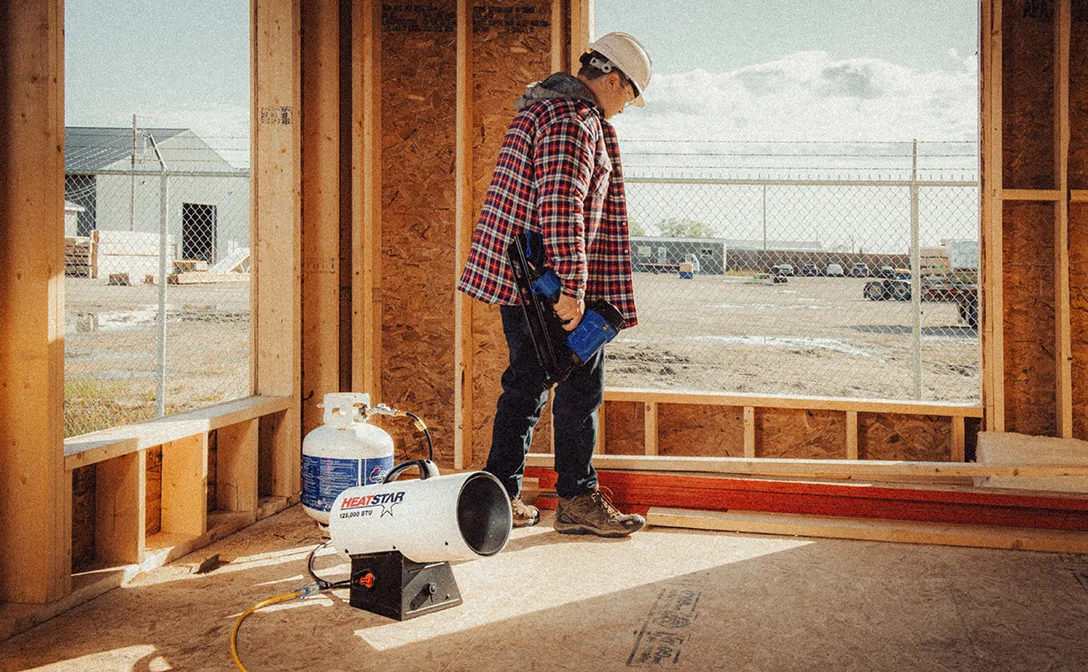
Find the right garage or workshop heater for your space. Explore radiant, electric, propane, and natural gas heaters with safety and BTU tips.
Many heaters will state their heating capabilities in square feet. However, this is often based on an 8- to 10-ft ceiling height. If your workspace has a much higher ceiling, and therefore a much larger cubic space, you’ll need a higher-capacity heater.
Most heaters will state their BTU capacity. Knowing how many BTUs your space requires will help you choose the right heater for your space.
Example: You have a workshop that is 20 ft in length, 24 ft in width and has a 16 ft ceiling. Your cubic space is: 20 x 24 x 16 = 7,680 cu. ftThen you need to determine the largest increase in temperature you need to attain. If your coldest normal temperature is –20ºC and you want to warm your space to +10ºC, that is a 30ºC difference.
Calculation: 7,680 cu. ft x 30º increase x 0.2394 (conversion) = 55,158 BTUIf you’re choosing an electric heater, you’ll notice it states its capacity in Watts instead of BTU. Use this to calculate how many BTUs: 1 Watt = 3.412 BTU 1 BTU = 0.293 Watts
Fuel burning heaters should only be used in well-ventilated areas
A carbon monoxide detector is recommended
Keep heaters a safe distance from combustible materials
Let your heater cool down before storing
Never leave your heater unattended
Cease operation if any gas odour is detected
Don’t use in areas of high dust content or if flammable vapours are present
Operate on stable level surfaces
Propane Heaters
Inspect hoses and regulator assembly for cracks and leaks.
Always turn off propane tank when not in use.
Cover disconnected fittings with caps so contaminants cannot enter.
Before first use of the season, check for any kind of debris that may have entered the heater.
Kerosene Heaters
Always use fresh clean grade #1 kerosene (1‐K).
Drain kerosene out before storing and burn off any fluid that may still be in heater’s line.
Inspect filters and spark igniters. They should be kept clean after hours of use to avoid any buildup.
Before first use of the season, check for any kind of debris that may have entered the heater.
Electric Heaters
Inspect power cords and plugs for any splits or cuts.
Keep element clean from debris.
Radiant Heaters warm objects that face the heater, in turn heating the surrounding area.
Available in Electric, Kerosene and Propane
Ideal for smaller spaces
Many models have low oxygen sensors
Various ranges of heat settings
Tip-over protection
Heater requires a built‐in fan to draw fresh cool air in and push heated air out. Propane and Kerosene are common fuels used.
Ideal for large spaces
Requires AC power outlet (for fan)
Certain models have thermostats
Safety shut off if loss of flame or power supply
These heaters are meant for permanent installation and are suitable for heating larger areas such as garages and workshops. A certified gas fitter must install all the piping and valves. Unlike other gas run heaters, these are installed with venting kits, moving the exhaust out.
Low profile design requires just 1 in. of clearance
Certified 4-in. Horizontal and Vertical vent kits are available
Includes analog thermostat and Natural Gas to Liquid Propane conversion kit
Compatible with Wi-Fi Thermostats (available separately)
Cool air is drawn into the bottom and hot air flows out the top. This creates a natural flow of air, making this one of the most efficient types of heaters.
Ideal for small to large areas
Requires no power outlet
Super efficient for heating
Can be “nested” for storage
Cools very quickly for transportation
Uses an electrical element to produce heat, much like the element in a stove. 120 V and 240 V models available. Models include:
Radiant
Infrared
Ceramic
Forced air