Store selector: No store selected

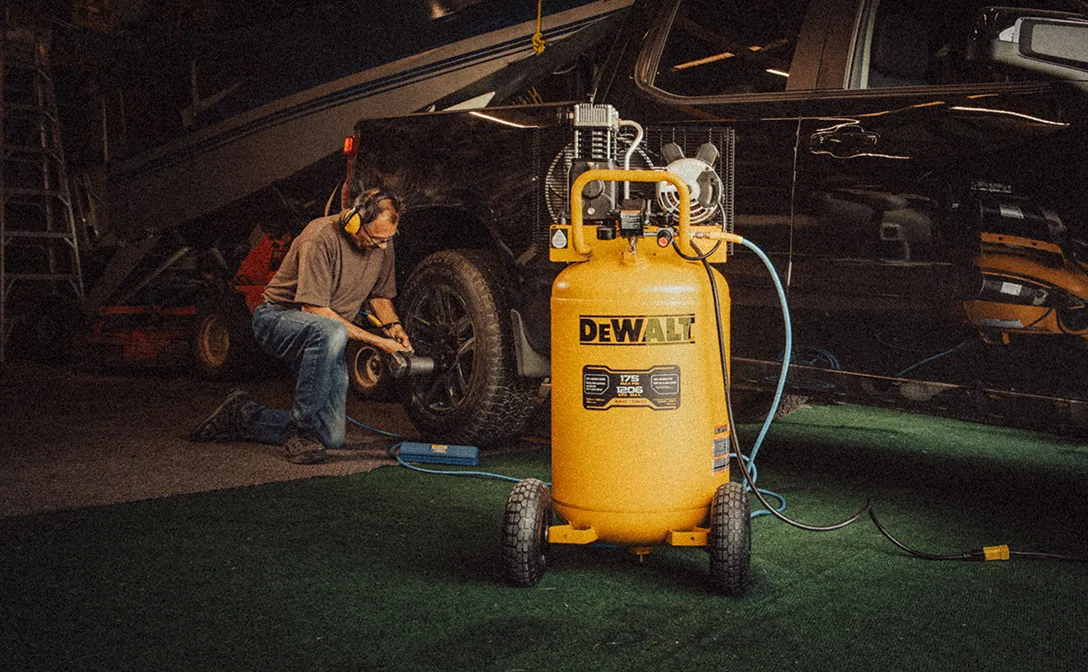
Choosing the right air compressor can improve your work. This is true for DIY projects and professional or industrial tasks. This air compressor buying guide helps you choose the correct air compressor; it covers portable air compressors for job sites and quiet ones for home use.
A good air compressor allows your tools work at peak efficiency while cutting down on task time as you work on projects in your home shop, outside or in an industrial environment.
The right air compressor doesn’t have to be the most expensive model. Consider the type of work you will be doing with it now, and in the future.
For example, you may currently need a compressor to run a 1/2 in. impact wrench for seasonal tire changes, filling tires and other small tasks. But if you’re planning to restore a vehicle and need to do some abrasive blasting, painting with a spray paint gun and use die grinders, random orbital sanders and other air tools that require a lot of airflow, upgrading to a higher-capacity compressor now will save you time and money in the future.
Related accessories such as hose reels, in-line air regulators, lubricators and dryers can be installed along with your compressor or can be easily added later.
Plasma cutters demand a high volume of dry compressed air, plus tools like die grinders and sanders to clean up surfaces after cutting. This would be a good time to consider all of your options including possible future upgrades with air dryers, filters and hose reels.
If it’s only for filling tires or blowing out RV water lines or underground sprinkler systems for the winter, a lower-decibel stationary or portable compressor would be sufficient. Accessories such as tire inflators, blowguns, fittings and more will have you ready for any job that comes your way.
Pro Tip: If more than one tool will be drawing air at the same time, calculate the SCFM (Standard Cubic Feet per Minute) requirements of all tools you’ll be using and multiply by 1.5 to avoid power drops. For example, an air compressor for a nail gun uses at least 2 to 4 SCFM, while painting may require 6 to 10 SCFM of air.
Electric vs. Gas Air Compressors
Electric Air Compressor: Clean and emission-free, ideal for indoor use in garages or shops. Quiet, portable versions are available
Gas Powered Air Compressor: Powerful and portable, perfect for outdoor job sites without access to electricity.
Oil-Free vs. Oil-Lubricated
Oil-Less or “Maintenance-Free” Air Compressor: Low-maintenance and less mess, great for painting, DIY projects or airbrushing.
Oil-Lubricated Air Compressor: Durable and high-performing, suited for heavy-duty tasks like automotive repair. Requires regular maintenance.
Single-Stage piston, Two-Stage piston or Rotary Screw?
Single-Stage Air Compressor: Affordable and effective for light tasks like inflating car tires or small DIY projects. These utilize a piston driven pump. These can be oil-less otherwise known as ‘maintenance-free” pumps, while others will have oil-bath “splash” lubrication style. Tank sizes range from 1 to 80 gallons.
2-Stage Air Compressor: Produces a higher PSI flow for demanding applications like CNC plasma tables, autobody sanding, painting and sandblasting. These will utilize an oil-bath or “splash” lubrication style, and tank sizes generally start at 60 to 120 gallons.
Rotary Screw Air Compressor: Works by trapping air between two rotating screws (rotors) and compressing it as the space between the screws gets smaller. This continuous compression creates a steady stream of high-pressure air. Rotary screw air compressors are designed for continuous operation and typically have a 100% duty cycle, meaning they can run constantly without needing to stop to prevent overheating. This makes them suitable for applications requiring a consistent supply of compressed air in industrial shop and manufacturing applications. Tanks sizes range from 60 gallons and up.
Air Compressor Tank Sizes and Electrical Requirements:
Small Tanks (1–30 Gallons): Found on portable air compressors, making them ideal for nail guns, tire inflation and light tool use. Generally, these compressors will have a 120V motor that requires less than 15 amps to power it. For most home workshop and jobsite scenarios, wall outlets and larger generators will provide the required power to run tools and equipment.
Large Tanks (60–120 Gallons): Commonly found on stationary single-stage, two-stage or rotary screw air compressors. Typically used in larger workshops and industrial applications where multiple tools are running simultaneously. Generally, these will require 240V (or higher) single-phase, 20A power. Contact a Licensed Electrician to verify your available power supply.
Key Features and Terminology to Understand:
SCFM (Standard Cubic Feet per Minute): A measurement of airflow. A higher SCFM can handle multiple tools or heavy tasks like providing continuous air for sanding, abrasive blasting or painting.
PSI (Pounds per Square Inch): Indicates pressure. A high-pressure air compressor (120+ PSI) ensures longer tool run times.
Single Stage Compressor Pump: Air is drawn into the pump and compressed once before moving to the tank and/or the air tools.
Two Stage Compressor Pump: Air is drawn into the pump, compressed once and then transferred into an adjacent cylinder, where it’s compressed a second time to a higher pressure before it goes into the tank and/or the air tools.
Rotary Screw Air End: This is where air compression takes place. Air is pulled between two rotating screws (rotors) that squeeze it into a smaller space, which increases the air pressure. The compressed air is filtered out of the pressurized oiling system through a drying filter and delivered to the storage tank and/or air tools.
Proper air compressor maintenance extends lifespan:
Drain the air compressor tank daily to prevent rust. Keeping the moisture out of your tank extends the life of your air tools as well.
Check and adjust drive belt tension as required.
For oil-lubricated compressors, change the oil and filters as recommended. Follow the owner’s manual for information and recommended maintenance schedules.
Inspect and clean air intake filters as required. Because carpentry shops and autobody shops produce a high amount of dust, consider installing your compressor in a separate room or setting up an air piping system to plumb the air into another room or space to work in. The air your compressor takes in
must
be as clean and dry as possible to minimize wear on the pump and air tools.
Shop Now: Check out electric, gas, and cordless air compressors, plus accessories. Find your perfect match!